 Some Trading ideas for 2026 Wimbledon Men’s Singles
The jewel in the grass court season is just around the corner with Wimbledon opening its gates for first round play next Monday, writes Dave Renham. The grass season comes and goes in a flash as it basically spans just five weeks; hence, in terms of individual grass court player stats, they are somewhat limited due to that short season and a general lack of tournaments. Indeed, players that tend to have a deep run in the French Open often skip the first grass court event due to timing issues, which limits stats still further.
To begin this article I want to analyse the advantage the server has on grass, focusing on the men. Below is a graph showing the differences across the three main surfaces (grass, clay and hard) in terms of service hold percentage on the Men’s ATP Tour. The percentages are the mean averages for each surface over the past two years. For this article I will be primarily using data covering the last two years.
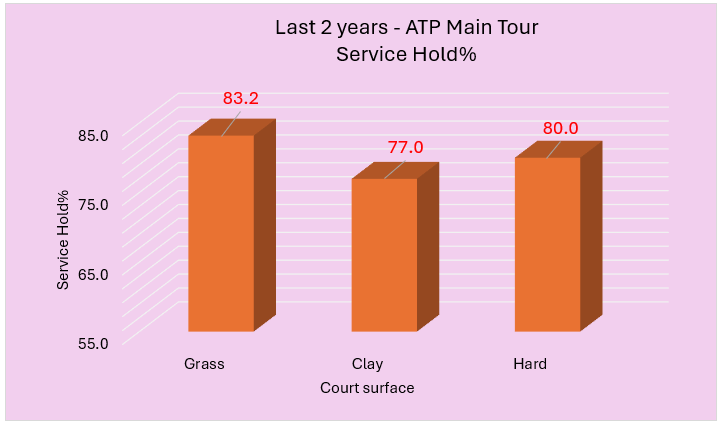
As we can see men hold their serve more often on grass than any other surface, with a significant difference between clay and grass of over 8% relatively. However, it should be noted that Wimbledon does seem to play slightly slower than most grass courts which has a small effect on the numbers.
In terms of the top men’s players, there are six who have a service hold percentage in excess of 90%. The six are shown below:
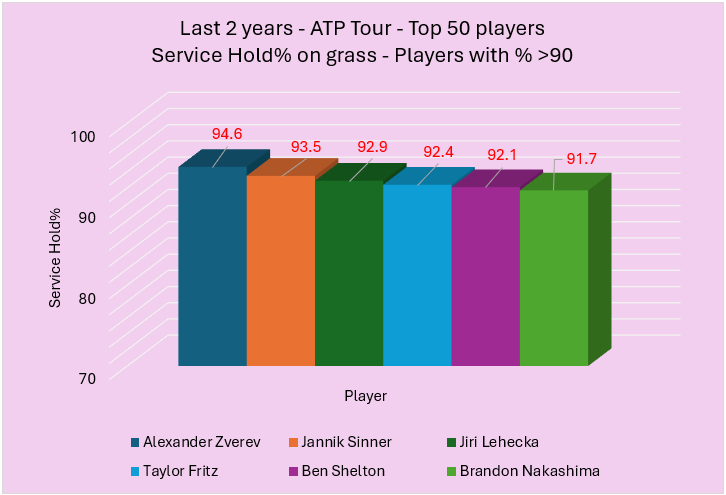
Strong servers on grass offer us the potential trading strategy known as ‘back the server’. This strategy is well explained on the Tennis Profits site by Paul, and is definitely worth checking out (members only) if you haven’t already, but I will highlight some of the key points he makes.
The ‘back the server’ strategy works best with men’s matches as they tend to have stronger serves. Paul also advises that you avoid players who are priced below 1.40 as the price move for a hold of serve is not really worth the risk.
For this type of trade, pre-match analysis will be vital as we are looking for players who have a good record of winning service games, such as the six seen in the above graph. Service hold% is probably the most important individual statistic, but also we want to see solid numbers for first serve percentage, first serve points won percentage, service points won, and ideally when it comes to saving break points. The table below shows the stats for our six players over the past two years on grass. Any percentage in green is above the tour mean average, anything in red below. I have also added the mean averages for each stat to the table:
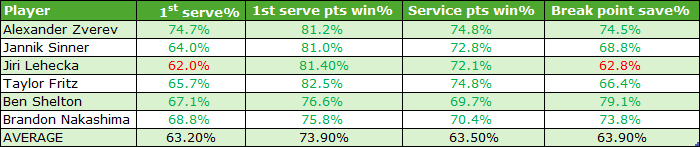
Based on these numbers it would seem that Zverev, Sinner and Fritz have a slight edge over the other three.
So how would we think about employing this strategy at Wimbledon having found a suitable candidate? I will let Paul explain:
To open your trade, back your player right before he starts his service game. It’s often a good idea to watch the first service game from each player without entering the market as some players can take a game or two to get their serve and ground strokes warmed up. As soon as the previous game has finished, place your back bet at the highest available price. The reason you do it as soon as the previous game has finished is that there are other traders who back the server and they will push the price down a tick or two. You want the best price available, so get in early.
As you get more experienced, you will be able to estimate where the price will move to before the previous game ends. You can then place your bet early. After a game ends, the price may overreact and “bounce” an extra tick or two. The better price you enter at, the more profit you can make. Every tick counts, so practice estimating where the price will bounce to and take advantage!
If all goes to plan, your guy will win his service game, and you can hedge for a guaranteed profit on both players. Again, try to estimate where the price will bounce to and enter your closing bet before the end of the service game. This takes practice, but it’s well worth the effort.
Now, as with some trades, it might not always go the way that we are hoping for. Hence, to use a ‘Paul rule’, if the server goes 0-30 down exit the trade for a loss. Wise words from an experienced trader, because although good servers will sometimes come back from 0-30 down to win the game, if we hang fire and the server loses his serve, the drop in price can be quite severe. He also suggests the same trade out for a loss plan if the game goes to 30-40 from 30 all. Ultimately, if one service game fails to pan out, we just need to accept it and cut our losses, as there will be plenty more games in said match to trade and back the server should we so wish.
It is very important to note that price movements for holds of serve will fluctuate differently depending on the scoreline. The price of the server, from the start of a service game to its end, will move less at the beginning of a first set than it would deep into the final set. If a player fails to hold serve near the end of the match his price will rise steeply, so getting out at 0-30 or 30-40 then is definitely advised, as losses will be far less steep if we do.
I can hopefully help bring some context to the last paragraph as I was watching the price movements in the Nakashima versus Cerundolo semi-final match at Queens in the final set. Nakashima is one of the players mentioned earlier who has excellent serving stats on grass. The score was 3-3 in that deciding set with Nakashima to serve. He was 1.90 to win and 1.91 to lay at the start of the game. The point-by-point score during this service game went as follows, with the relevant prices:
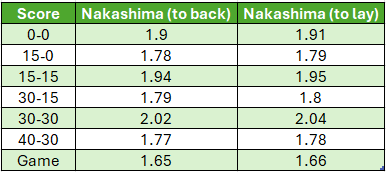
From the start of the game to its conclusion, the Nakashima back price dropped 25 ticks from 1.90 to 1.65. Backing at 1.90 and trading at the best lay price of 1.66 at the end of the game would have yielded a tidy profit. As we can see from these numbers, holding serve late on in a match can see a significant drop in price offering good trading opportunities. But… continuing the story from this match, Nakashima served again at 4-4 and lost his serve, as a result of which his opponent’s price dropped to 1.14 to back. This just shows the risk reward scenario that we, as traders, need to manage.
Actually, that match represented Nakashima’s worst serving performances on grass ever, which should have tempered one’s enthusiasm for using the ‘back the server’ strategy in that final set: up to 4-4 in the final set, he had already been broken five times, so that was the sixth break. Compare this to the previous three matches at Queens where he lost his serve just once across all three matches! Perhaps the writing was on the wall early in that semi as he was broken in the very first game of the match.
There are a few other points to be aware of when thinking about backing the server, especially if trying this at Wimbledon this year. At Wimbledon, the men play over five sets so if trading a match there will be potentially more opportunities to ‘back the server’ than there would be in a normal best of three. However, on the flip side, we should expect to find that price movement early in the first set will be minimal. Indeed, we need to be aware that there will be times when the server’s price may not move even if they win a game. This is especially true if the server struggles his way through a service game, maybe fending off break points along the way.
For example, in the Fritz v Tiafoe Berlin final on Sunday 21st June, at 2-2 Fritz’s price was higher at the end of the game than it was at beginning. He was 1.53 to back at the start of the game and 1.57 after winning it. The reason was that he saved three break points at 0-40 in that game and, in the previous game, he also had to save a break point. The market was aware that he was not serving or playing at his best which helps explain the unusual price movement.
To improve our chances of using the ‘back the server’ trade successfully, it helps if the opponent has poor stats when it comes to returning. This of course should increase the chance of the strong server holding serve even more often. Below is a graph showing the ten players in the current top 50 with the lowest percentages for breaking serve.
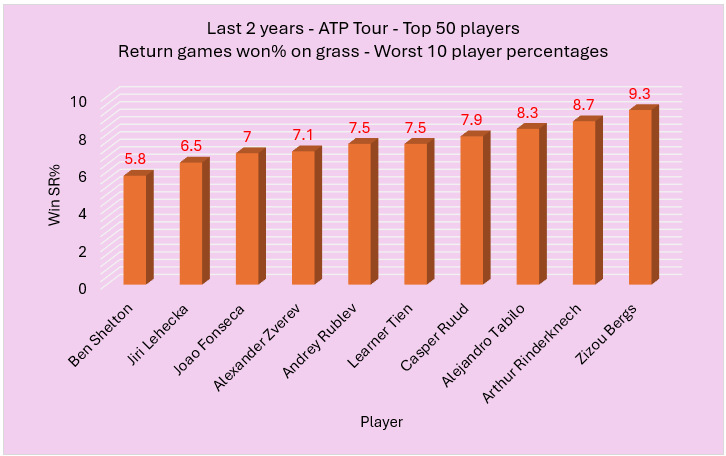
It is worth pointing out that three of the worst four percentages come from the group of strongest servers shared earlier, namely Shelton, Lehecka and Zverev. Generally, some of the best servers of all time have been the poorest returners such as John Isner and Ivo Karlovic. I guess, any very tall strong servers find moving around the court more challenging making returning games much harder to be competitive in.
Another trading strategy discussed on the site is ‘back your favourite’. Note this is not a strategy called ‘back the favourite’ although ‘your favourite’ may actually turn out to be the favourite. When researching a match in detail, we may come up with a player who we feel will win or at least will perform well early. If this is the case, then we can take a position pre-match by backing our favoured player. Using this approach, we can take full advantage of the drop in their price if they break their opponent’s serve first or indeed get break points. Now, again, in a five-set match an early break will have less effect on the price than if the match was over three sets, but it should move enough for us to take a profit.
If our favoured player happens to be favourite, we need to be aware that it is rare to get a value price on the favourite at the start of the match. However, the price wouldn’t need to move too much early on for the price to become value. Hence, it is often a good idea to hang fire on entering the market until your player is a bigger price. Such entry points could include when your player is facing a break point, but of course there is plenty of jeopardy there. I personally would prefer entry points such as 30-30 on serve, as the ATP average in terms of the server still winning the game is around 75%. Also, the longer the first set goes the price of the favourite does start to drift out. So maybe enter at 4-4 in the first set, as long as we are happy with how our player has played these early games.
*
To finish off I thought it would be worthwhile looking at some favourite stats for Wimbledon over the past five years. This will give us some useful information if we find a match where our favourite player is favoured in a match. Below is a breakdown by round for the win percentage of the favourite. To get a bigger sample for the later rounds I have lumped the quarter final, semi-final and final results in together.
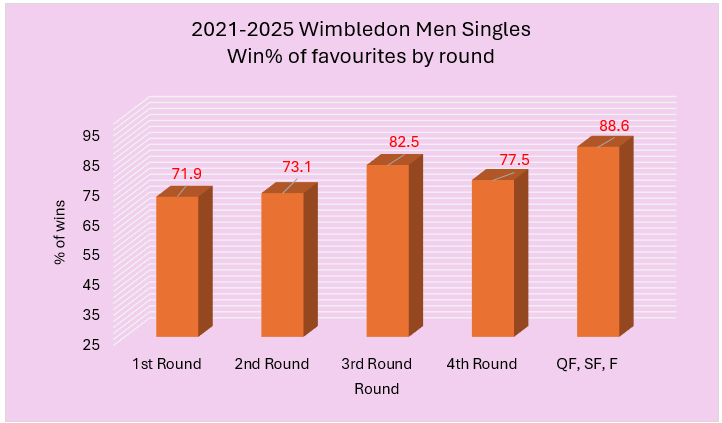
Favourites have performed worst in rounds one and two, in that order, while from the quarter-final (QF) stage onwards they have performed exceptionally well, winning 31 of 35 matches for a percentage not far shy of 90%. Backing all favourites from the QF stage onwards since 2021 would have yielded a return of roughly 16% at best prices, and probably around 20% if using the Betfair exchange.
From a trading perspective, favourites in the latter stages of the Men’s Singles at Wimbledon may offer traders a positive ‘early in’. Not only did 31 of last 35 favourites win during those final three rounds, but three of the four losses saw the favourite win the first set, thus giving traders a potential ‘exit’ in those matches, too.
If trading at Wimbledon, good luck, and do your prep; if going to Wimbledon, if you’re there on the first Monday, I might see you!
– DR