 French Open Women’s singles – a dig into the last ten years
The 2026 clay court season has already provided a few shocks on the women’s side, and next week we will see the start of the second Grand Slam of the year in France at Roland Garros, writes Dave Renham. In this article I am going to look for pointers from previous French Open tournaments, looking at some facts and stats centred around the Women’s Singles event. The data collected are from the last ten years of this event. I will also give some thoughts about the 2026 renewal.
Finals
Let me start by analysing the finals over the past ten years. Top seeds have done well, reaching six finals, but when looking at the decade as a whole, we see a spread of player rankings making the final. The graph below shows this fact neatly:
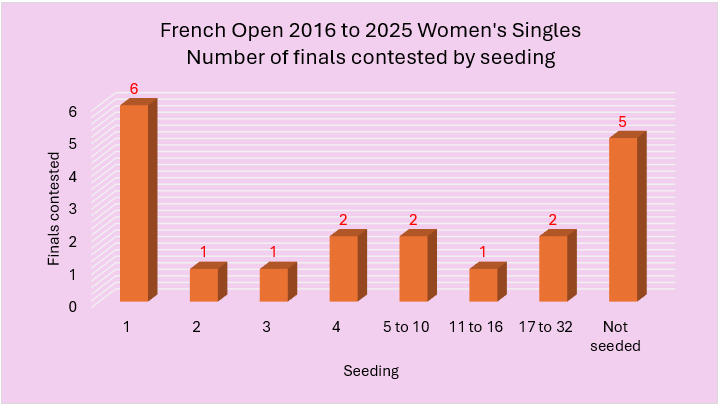
As we can see, five of the 20 finalists were unseeded of which three won: Ostapenko in 2017, Swiatek in 2020 and Krejcikova in 2021. Ostapenko was ranked 47 in the world when she won, Swiatek was ranked 54 and Krejcikova 33. Therefore, the women’s tournament has rarely gone to script, unlike the men’s. In the men’s event, all ten finals were contested by two of the top eight seeds.
Below is a graphical comparison between the men and the women in terms of finals and the seeding of players that reached said finals.
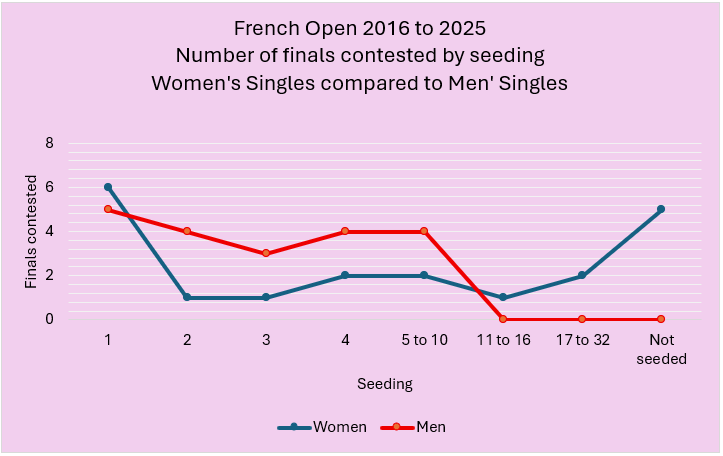
Graphs are often an excellent way to compare two data sets. There is a stark difference between the blue line (for the ladies) and the red line (for the men). It clearly confirms what I shared earlier in terms of the pure numbers, that the men’s event has gone much more to form / seeding than the women’s, as far as the two players reaching the final is concerned.
Women’s Round 1
Let me now share some 1st Round data based on the last ten French Opens.
Favourites in first round matches have won 72.1% of the time which is virtually the same as we saw in the Australian Open (71.9%). Backing favourites would have offered better value than backing the underdog at this first round stage. The underdog would have lost us around three times as much as backing the favourite.
Having said that, we would have still made a small loss if backing every favourite.
In terms of the top players, here is the 1st Round record of the top 16 seeds over the ten years:
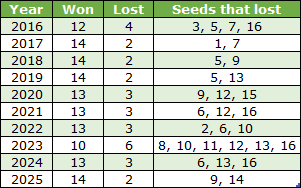
As we might expect, there were far more wins than losses – overall, the win rate stands at 81.3%. This is 3.4% lower than the figures for the Australian Open (2016-2025) which was 84.7%, so the seeds have found it slightly harder going here than in the first Slam over the past ten years. 2023 was a particularly difficult year in Paris for the women’s seeds with six of the 16 losing.
Favourites across all the rounds
Time to analyse favourite performance across all rounds now. Below is a graph showing a comparison of the win percentage round by round for the market leader in each match:
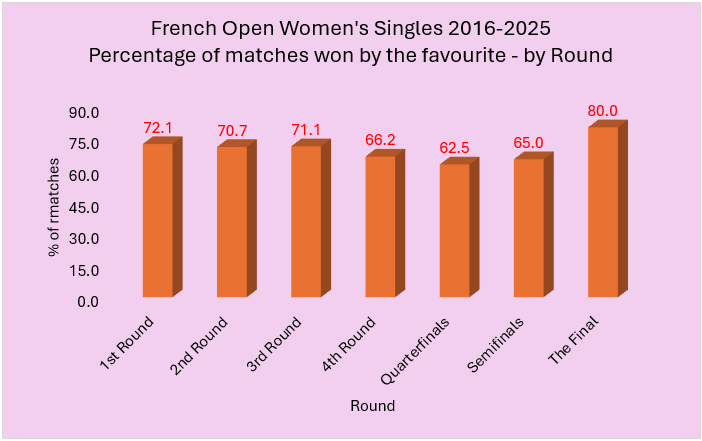
We see a similar strike rate across the first three rounds, with a small dip from the fourth round through to the semis. Favourites have performed very well in the final, winning eight of the ten, but of course the statistics for the final comes from a small sample.
Semi finals
Let me now share some data for semi-finals. We saw that the final often included players we might not have expected. Not surprisingly perhaps, the same has been true for the semi-finals. Below is the same type of graph I shared earlier when looking at the last ten finals – this one shows the number of semi-finals contested based on different seeding positions across the ten tournaments:

40% of the semi-finalists were not seeded, meaning they were outside of the top 32. For the record this includes one qualifier (Nadia Podoroska in 2020) and one wild card (Lois Boisson in 2025). Therefore, for those who are looking at the outright markets then there should be some value around some of the outsiders – though it won’t be easy finding the right outsiders!
First Set Score
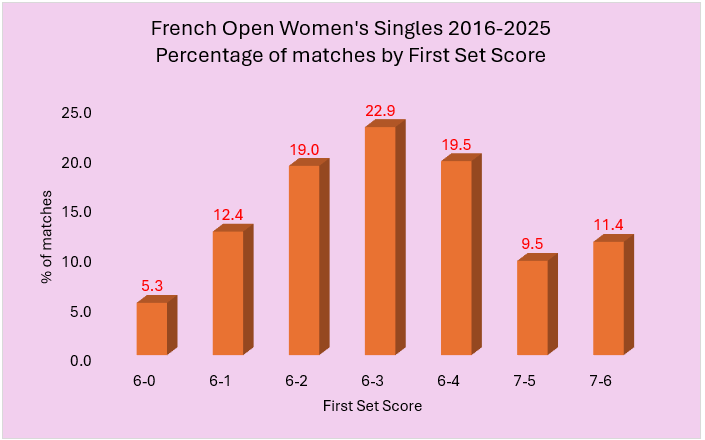
For those who may wish to bet on the first set score, let me share the percentages for the different first set scores across the last ten French Open Women’s Singles.
The 6-3 scoreline has occurred the most, occurring in just under 23% of all matches. 6-4 and 6-2 are next in line with, unsurprisingly, 6-0 happening the least.
Set Score
Onto set scores now. Below is a graph showing the percentage splits for set scores from completed matches – so either 2-0 or 2-1 set scorelines:
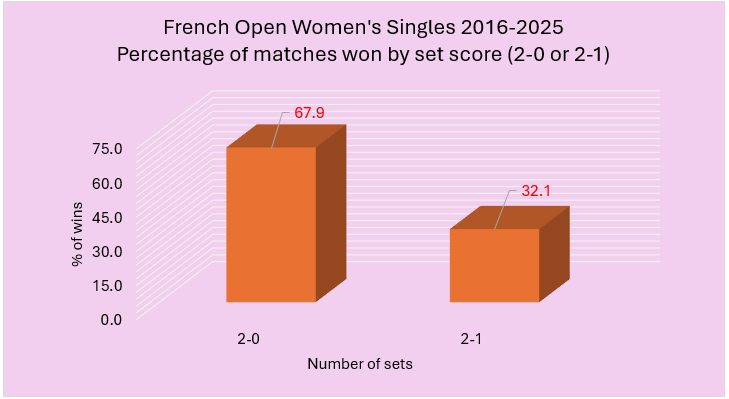
These figures are very similar to what we should expect as the percentages for all matches across the WTA tour in the last year are nigh on the same. So, on average we can expect one in every three matches will go to three sets.
In terms of trading, the first set score is usually a good indicator of how likely the match is likely to go to three sets. Below is a graph showing the percentages of matches that went to a third set based on the first set score:
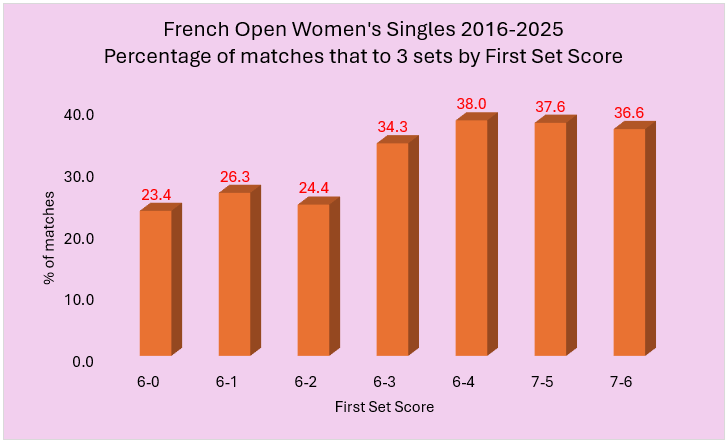
These percentages make sense. Closer first sets in terms of scoreline have produced a higher percentage of matches that went to a third set. The 7-6 percentage is slightly below the norm for WTA tour matches which is just above 39%. For those fans of trading after the first set, I would be taking a note of that first set score.
Women’s Singles tournament 2026
As I suggested in my Australian Open deep dive, from a pre-tournament perspective I think there are two markets to consider – the Outright Win market and the Winning Quarter market. With the Exchanges giving us scope to trade out from our position at any point, it potentially offers a little ‘insurance’, assuming our pick or picks start the tournament well and progress through the early rounds.
So where should we be looking?
The top two in the market are arguably the most likely winners but both come into the tournament with question marks.
World number 1 Aryna Sabalenka has played two clay events, losing in the quarters of Madrid and the last 32 of Rome. Both defeats were against players outside the top 25. She is around 11/4 best price at the time of writing which looks a tad tight to me.
Iga Swiatek is favourite or joint favourite with all firms and is generally a 5/2 chance. Swiatek was almost unbeatable on clay between 2022 and 2024 where her win rate was a huge 92%. However, last year this dropped to 73% and currently in 2026 it is 66.7%. There were good signs in the recent Rome tournament where she won three back-to-back matches very easily against Cocciaretto, Osaka and Pegula, looking back to her best in the process. However, she then faltered in the semis, losing to Svitolina. If she can build on that recent improvement, then she is definitely the one to beat having previously won four French Opens in 2020, 2022, 2023 and 2024. At her very best a price of nearer 6/4 would be fair, so her current price seems about right.
Last year’s winner Coco Gauff is currently on offer between 6/1 and 9/1. As I am writing this, she has just reached the final of Rome, so she seems to be hitting form at the right time. In my opinion, at the current prices she is much better value than either Swiatek or Sabalenka.
Mirra Andreeva has played in four tournaments this clay court swing, winning in Linz, reaching the final in Madrid, the semis in Stuttgart and the quarters in Rome. She has won 15 of 18 matches across these four tournaments and at 8/1 merits serious consideration. She is a danger to anyone on her day.
Elena Rybakina won in Stuttgart but lost in the last 16 of Madrid and in the quarters of Rome. She has had an excellent year overall, but clay is not her best surface and at around 7/1 I don’t see this as value. She can win of course, but to be interested I would need a price nearer 10/1 or 11/1.
Away from the favoured end of the market I think Qinwen Zheng is interesting. She had surgery on her elbow back in July 2025 and only started fully back on tour in February. She has played just 12 matches this year, with seven wins and, on clay, she has won three of five. Her overall clay credentials are decent, boasting a 71% win rate in her career as well as winning the 2024 Olympic title at the Roland Garros venue. In the Madrid Open this year she pushed Rybakina all the way in a tight three setter and at a best priced 66/1 that looks far too big. It would be ideal if she could avoid one of the big guns in the first couple of rounds, being ranked outside the top 32, but her odds more than make up for it. We also need to remember that 12 months ago she was world number 4. I have backed her each way (1/2 odds) at 66s.
So, it is Gauff and Zheng for me, and I might add Andreeva once I’ve seen the draw.
Good luck for punters and traders alike for this upcoming tournament. Along with my outright picks I will be trading several matches over the two weeks of the main tournament.
– DR