
 Australian Open Women’s singles – a dig into the last ten years
The new tennis season is starting to click into gear and in a few days’ time we will see the start of the first Grand Slam of the year in Australia, writes Dave Renham. In this article I am going to look for pointers from previous Australian Open tournaments specifically in the Women’s Singles event. The data collected is from the last ten years. I will also offer some thoughts about this year’s event.
A Quick look at the Men’s Singles
Before looking at the women’s event, let me talk about the Men’s Singles briefly. Essentially, the Men’s Singles at the Australian Open has tended to go to script. There have only been four different winners across those ten years – all of the ‘big three’ have won it (Djokovic five times, Federer twice and Nadal once) and for the last two years Jannik Sinner has triumphed.
Indeed, the final has generally been contested by two of the top players. To put this in context, 18 of the 20 finalists were ranked between 1 and 6, with only one player outside the top ten making the final. For the record, that player was Roger Federer with a false ranking as he had missed the last five months of the previous year which saw his seeding drop markedly. I’ll dig deeper into the finals of the ladies shortly, as well as show a graphical comparison between the men and the women in terms of the rankings of finalists.
Hence, the Men’s Singles tends to be easier to predict. The final also tends to go to script with the favourite winning eight of the last ten finals. Therefore, based on the past decade, we should not look outside the top four or five ranked players. In addition, form over the most recent six to twelve months points to the very best players – in this case, the top two players currently in the world namely Jannik Sinner and Carlos Alcaraz. They have been head and shoulders above the rest and, as I am penning this, ten days before the start of the main draw, the bookmakers have Sinner best priced at Evens and Alcaraz at 13/8. This equates to an 88% chance of one of the two winning, which in truth looks pretty close to the mark.
It would be a brave person to bet against one of these two winning it, but does either price offer any value? Personally, despite being a fan of Alcaraz’s tennis ability, I am wondering if the recent coaching change is going to hinder him for a few months. That personnel change was a huge surprise (to me, at least) and is going to be a significant transition which will take some adjusting to.
Additionally, Alcaraz has never been past the quarter-finals in the Australian Open, albeit he has only played in four, in two of which he was aged just 17 and 18. Sinner is the shorter price but looks the better value to me. Taking such a short price on a player to win seven three-set matches over two weeks is always a risk, even if they are the best player in the world. It is not my preferred betting strategy to bet this type of price, and although I won’t be backing him, if he avoids injury through the tournament even money could look very good value come the end of it!
Of the remaining players are there any that may trouble the top two? The only possible outsider I could consider is Novak Djokovic. Yes, he is past his prime, but jeez, how good was his prime?! Yes, his body seems to be failing him late on in Slams these days. Yes, Sinner seems to have his number having won their last five encounters. However, we are talking Djokovic in Australia – he is a ten-time Australian Open Champion.
Djokovic proved last year when beating Alcaraz in the quarters that he could still be as good as anyone on his day. Indeed, he reached the semi-final stage in every Slam of 2025 despite those advancing years. If he gets to the semi-final injury free, it would be churlish to discount him. I also think his chance increases if he is in Sinner’s half of the draw which means in this scenario, he will play Sinner in the semi rather than the final. He is likely to have more in the tank in the semis I feel which improves his chances against Sinner. If they did meet in the semis and Djokovic was able to a pull a rabbit out of hat, then he will face an easier opponent in the final (on the basis that every play in the draw is easier than Sinner). Of course, Alcaraz would be the most likely opponent, but if I’m right about the coaching change having a short-term negative effect on him, it might be that we see someone else sneaking through the back door in the final. If that was the case, Djokovic would be favourite – again assuming his body is still in good enough order.
Anyone looking to back Djokovic should probably look to the Exchanges to get the best value – currently around 19.0 (18/1). From a personal perspective, the outright market for the men is not for me this time around. However, I wouldn’t put anyone off taking the even money for Sinner, or throwing a small dart at Djokovic at around 18s.
Women’s Singles
Now, onto the Women’s Singles which has a more open look to it. Before looking at some of the contenders for this year, let me share some stats from the past ten years.
Women’s Singles final
Earlier in the piece I discussed briefly the rankings of players that have gone on to make the Men’s final over the past ten years. Below is a graph showing the number of finals contested based on different ranking positions in the Women’s Singles:
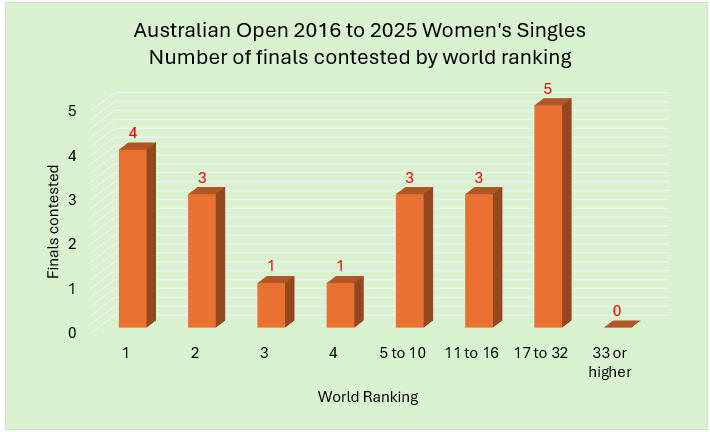
As we can see only nine of the 20 finalists were ranked in the top four, with eight coming from outside the top 10. In the past therefore, there would have been some real value looking outside the top four ranked players. It should also be noted that, come the final, the favourite has prevailed just five times out of the ten. Backing the favourite at best prices across the ten years would have seen us lose 34% of stakes. Conversely, backing the outsider of the two would have yielded five wins and returned over 70% on investment. This bottom line could have been increased a little if backing on Betfair pre-match.
Earlier I mentioned I would be making a graphical comparison between the men and the women in terms of finals and the ranking of players that reached them. Here is that graph:
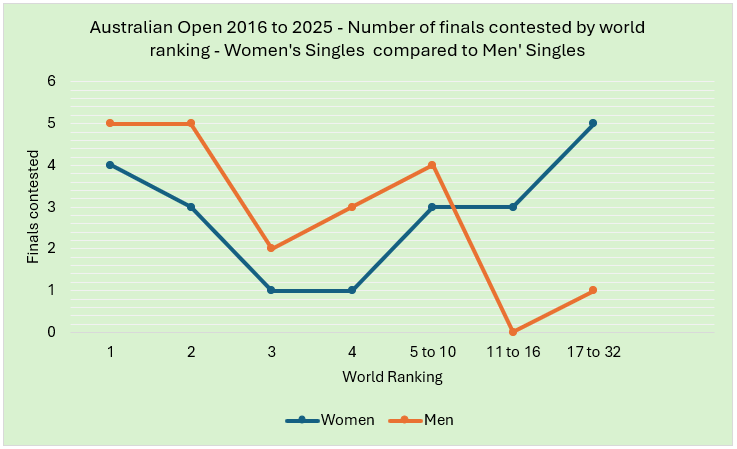
Graphs are often an excellent way to compare two data sets, and this one is no exception. There is a stark difference between the blue line (for the ladies), and the orange line (for the men). It clearly shows that in terms of finalists the men’s event has gone much more to ‘form’ / world ranking than the women’s event.
Women’s Round 1
Let me share some 1st Round stats now based on the last ten Australian Opens. Favourites have won just under 72% of the time (71.9% to be precise). Backing favs would have offered much better value than backing the outsider of the two at this first round stage. Backing the outsider of two would have lost us close to five times as much money compared to backing the favourite. Having said that, we would have still made a small loss if backing every match favourite.
In terms of the top players, if we look at the top 16 seeds by year, here is their 1st Round record:
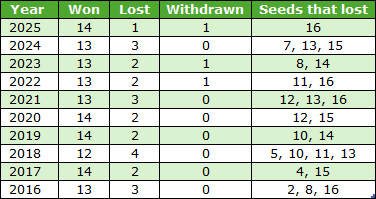
As we would expect, there were far more wins than losses – overall the win rate stands at 84.7%. Most of the losses came from players seeded 10 to 16, (18 in total), compared with just six losses from the top 9. Hence, it does seem that those seeded 10 to 16 have perhaps been a little vulnerable. I guess, lesser ranked players playing seeds 10 to 16 see it as a big opportunity to cause an upset. It might make sense, then, to have a look at the 1st Round matches this year for those seeded 10 to 16 to try and find lower ranked opponents who could be a potential banana skin.
For those who like accumulators, backing the top eight seeds in an eight-fold acca in Round 1 would have been a profitable strategy taking the last ten years as a whole. There would have been five winning years out of 10 for a profit of £593 to £100 level stakes. This year I think this bet may again prove a sound investment based on the current world rankings and likely top eight seeds.
Favourites across all rounds
So far, I have shared the winning percentages for favourites in Round 1 and in the final. Below is a graph showing a comparison of the win percentage across all rounds:
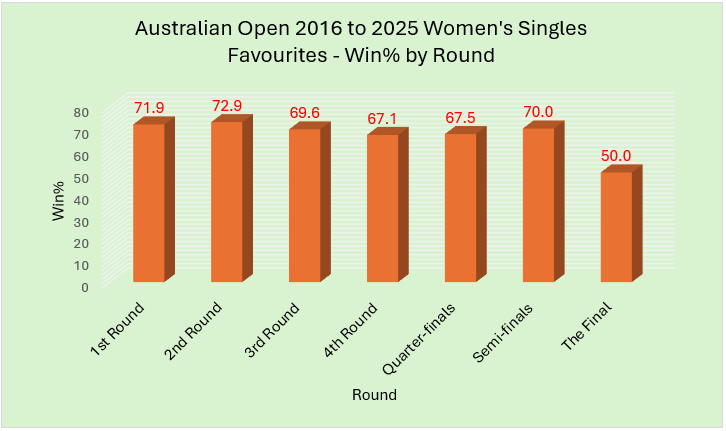
We have a similar strike rate across all rounds bar the final, but of course the final has a small number of matches when compared with previous rounds, especially Rounds 1 and 2. Overall, favourites have done slightly better in the first two rounds, but in truth this edge has been minimal.
Semi finals
Before I discuss this year’s event, let me share some data for semi-finals. We saw that the final often contained players lower ranked than we might have expected. Not surprisingly, the same has been true for the semi finals. Below is the same type of graph I shared earlier when looking at the last ten finals – this one shows the number of semi-finals contested based on different ranking positions across the ten tournaments:
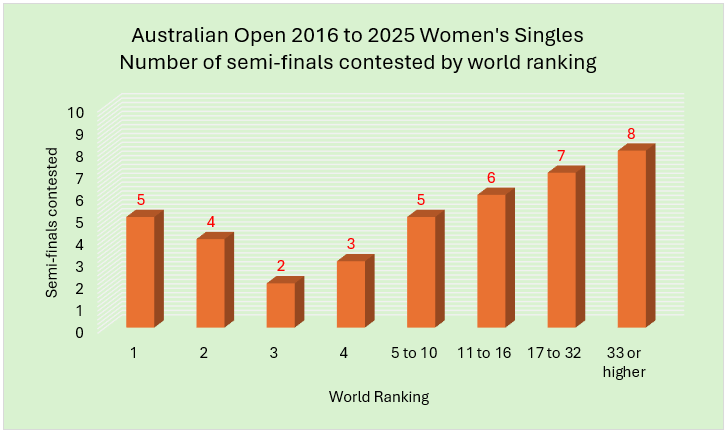
15 of the 40 semi-finalists were ranked outside the top 16, with 21 outside the top ten. For those who are looking at the outright markets then there should be some value around.
Women’s Singles tournament 2026
From a pre-tournament or ante-post perspective I think there are two markets to consider: the Outright Win market and the Winning Quarter market. With the Exchanges giving us scope to trade out of our position at any point, it gives a little ‘insurance’, assuming our pick or picks start the tournament well and progress through the early rounds.
Let me look at the top six seeds:
Aryna Sabalenka – World number 1 and the obvious starting point. She won the Australian Open in both 2023 and 2024 and reached the final last year losing a tight three-setter to Madison Keys. Therefore, she has course form, using a horse racing analogy. She reached two other Slam finals last year, winning the US Open, while her loss to Coco Gauff was in another close three-setter at the French. As I write this, Sabalenka has just beaten Keys 6-3 6-3 at Brisbane to reach the semis. [She has gone on to win the tournament without dropping a set – Ed.]
Her early season form looks good. Her current Betfair price of 3.1 looks fair enough though with limited margin for error.
Iga Swiatek – At her best she is a real threat to Sabalenka, but consistency has been an issue for her recently. Winning Wimbledon last year was a huge achievement on an unfavoured surface, but she capitulated in some final sets later in the year when the pressure was on. One such occasion was at the end of season Tour finals against Elena Rybakina. Swiatek won the first set 6-3 before losing the plot, winning just one more game as Rybakina won the next two sets 6-1, 6-0. As a result of her recent inconsistency her price is bigger. There are risks attached to backing her I feel even at her current Betfair price of around 7.0.
Coco Gauff – If Gauff can serve well, or more especially limit her double fault count, she will have a decent chance. She is a two-time Slam winner at age 21 so we know she can go all the way. A semi-finalist here in 2024 is her best AO result to date. I’ll be watching her serve in the first couple of rounds very closely. Currently 12.0 on Betfair.
Amanda Anisimova – 2025 was a stellar year for the American having been ranked 35 going into the 2025 Australian Open and ending the year as world number 4. At her best she is destructive with arguably the best backhand on tour. At her worst – the Wimbledon final springs to mind – the wheels can come off. Her current price on Betfair is 13.5.
Elena Rybakina – She has the strongest serving stats and in 2025 held serve 82% of the time which was comfortably the best on Tour. However, despite this huge weapon, success in Slams has been limited. She did win Wimbledon in 2022 and reached the final here in 2023. However, other than that she has just one other semi-final showing to her name. In six other attempts in Australia, she has failed to make it past the fourth round, and in the last four years (16 Slams) she has failed to get past the third round in eight of them. She is currently third favourite on Betfair at 10.0, but that looks short based on those last 16 Slams.
Jessica Pegula – Pegula is the outlier in terms of price as currently across the bookmakers she lies between 28/1 and 40/1, and on Betfair she is currently best priced 48.0. On the face of it her Grand Slam record is quite modest, but in the last two US Opens she has reached the final and the semi, and in Australia she has reached the quarters on three consecutive occasions between 2021 and 2023. Her career record shows she is far better on hard courts than on clay or grass which is a positive, and at 31 she is probably running out of time to win that elusive Slam. One would think that this year could be her last genuine chance of getting that monkey off her back.
The top six, concluding thoughts – I can’t see Aryna Sabalenka falling before the latter stages by which time her price will have contracted. I think backing her pre-tournament at the current 3.1 and then laying her later in tournament is a play. Based on past Grand Slams where she has reached the quarters or better, I reckon her price will be around 2.6 to win the tournament before the quarter-final and around 2.1 before the semi. This of course is assuming she at least reaches those stages. I think a sound play is to back Sabalenka now and aim to lay-off for a free win bet at the last eight or last four stage.
Of the remaining players, I couldn’t have Swiatek at the moment, but I did say that before Wimbledon – whoops! The other four all have positives and negatives, but I am edging towards Jessica Pegula simply based on a much bigger price. She has made at least the quarter finals in six of her last ten hard court Slams, so if she can do that again we would have good laying off / trading opportunities. Also, her all-time record against top five opponents is strong (won 19, lost 20) and she stacks up well against Gauff (leads their head-to-head 5-3), Anisimova (leads their head-to-head 3-0) and Rybakina (leads 3-2). Against Swiatek she is 5 wins and 6 losses, and it is only Sabalenka where she has struggled, winning 3 and losing 9 of their 12 meetings. When the draw comes out it would be an added bonus if she was not in Sabalenka’s quarter. If that is the case, then she would be worth a look in the Winning Quarter market as well.
A Lively Outsider? – As I shared earlier, there have been several lower ranked players making the semis here in the past years – Yastremska, Linette and Lucic-Baroni to name but three. Hence, there is likely to be some value out there on one or two outsiders. The problem of course is finding those players. I could make a case for a few, but the one I like the most is Elina Svitolina. Like Pegula she is 31 years old and running out of chances most likely. In her last six Slams she has reached the quarters on three occasions and as I write this, she has won the 250 event in Auckland, so she has started the year on a very positive note.
She will be seeded around 13 so will avoid a top 16 player until the fourth round should she win her first three matches. Currently she is over 100s on Betfair and so I feel there is scope to back early with a view to trade later.
A final point is that the draw will be important and could see some prices change. It is also likely that it will help pinpoint some other viable pre-tournament betting options especially in the quarter betting markets. Whatever bets and trades you make, I wish you a profitable first Grand Slam of the year.
– DR


Thank you for the excellent data information and easy to understand graphs.
Brilliant as always thanks Dave. Loving your insights on this one as its close to home so I get to see the games at a reasonable hour !
Thanks for kind comments. Just a quick update that if you had backed the top eight women’s seeds in a first round acca you would have won your bet again this year. Best price this time though was a little shorter than previous years at around Even money.
Dave
With Svitolina safely into round 4 I am looking to trade a bit out now. She has a potentially tough fourth rounder and she has dropped about 60 ‘ticks’ since I backed her pre tournament. Pegula is 1.08 to win her third round match so I’ll wait to trade her back, although she has halved in price on the outright market since I backed her.
Sabalenka has dropped in price as expected – available to lay at 2.42. I bagged 3.55 pre tournament so have an option of greening up or having a free bet on her effectively at just over Evens. Or holding out for a bit longer ……. Svitolina into quarters as well – price now around 80% lower than pre-tournament.