
 A week trading Indian Wells
Straight off the bat, although I write and research tennis trading and betting articles, it is important to stress that I am not a full-time tennis trader, writes Dave Renham. I wear a number of other hats workwise including as an online maths tutor and as a regular researcher / contributor to the excellent horse racing website www.geegeez.co.uk. Consequently, my time to trade tennis matches tends to be limited. Also, I am not a huge fan of late-night trading and when the tournaments are outside Europe a lot of matches tend to be late at night or indeed overnight. Effective trading needs complete focus with no distractions or losses of concentration. I must admit there are too many times in the past when I have not been at my most effective, especially late at night having been working on other things during the day.
On to the article. In this piece I am going to walk through all of the trades I made in the first week of Indian Wells. Indian Wells is a 1000 event with tournaments for both men and women, and some people liken it to a fifth Slam. It is the first part of what is known as the ‘Sunshine Double’ with Miami following hot on its heels. Being in the US, the timing of matches is not ideal for me, as stated above, but I reorganised Indian Wells week and had a week off tutoring and researching. That meant I could relax during the day and be fully ready to potentially trade one or more of the evening matches.
In terms of the money I stake, I will not divulge the actual amount in sterling – it’s not at all relevant to an article about the mechanics of trading – and will instead use ‘units’. Suffice to say I am not trading in the volumes that the excellent Paul Shires does, but nor is it for pennies either! I use Bet Angel Pro software to make the trading process quicker and easier.
Monday 2nd March 2026
Day 1 saw some qualifying matches taking place on both the men’s and women’s side. If you have read my previous articles for tennisprofits.com you will know that I prefer WTA matches as there tend to be more fluctuations and breaks of serve in those matches. On this day I spent the morning scanning through the matches scheduled for that evening and two caught my eye: Hon v Zarazua and Boulter v Tomova.
These were my pre-match thoughts for both:
Hon v Zarazua
These two players had met a week before in Mexico in a topsy-turvy match that went three sets. Hon came out on top in that one winning 6-4 in the third, but there were 13 breaks of serve in the match from 26 service games so 50% of them ended up with a break of serve. Indeed, in the second set there were five breaks of serve in a row. This looked an ideal match to trade if that recent encounter was anything to go by.
Boulter v Tomova
Being British, I have watched a lot of Katie Boulter over the years and feel I have a very good appreciation of her game, including her strengths and weaknesses, and how her matches can play out. Boulter, after a tough 2025, has started 2026 on a much more positive note. She won the Ostrava WTA 250 tournament in the Czech Republic at the beginning of February and followed that up by reaching the quarter-finals at Merida before losing in three sets to top seed Jasmine Paolini.
Tomova I knew less about but at least I had seen her play before. Ranked 151 she came into the match as a big underdog. My plan for this one was to watch the first set and potentially get involved in the second. If Tomova won the first set, I would look to lay her; if Boulter won the first set, I would wait to see how the start of the second set unfolded before deciding whether to make a ‘play’ or not. I looked at a variety of past stats and one that caught my eye was the poor next game record of Tomova after breaking her opponent’s serve. 49% of the time in the last year she had lost her serve giving back that break immediately. The tour average for this happening is 33%, Tomova being 50% above that figure.
Match 1: Boulter v Tomova
Fast forward to the evening and the Boulter v Tomova match started first. As mentioned in the previous paragraph I had planned not to get involved in the first set, so I simply watched the first set taking a few notes along the way. Boulter started positively forcing Tomova’s first service game to deuce and, although she failed to break, Boulter held her first service game to love and broke in the next game to lead 2-1. At 40-15 in the next Boulter looked likely to go 3-1 but Tomova won four points in a row to break back. Boulter broke again in the seventh game and although she failed to take two set points on Tomova’s serve at 5-3, she served it out in the next to win the first set 6-4.
The first set had been quite tight despite Tomova being ranked over 80 places below the Brit. My plan having watched the first set was to potentially enter the market if Boulter broke first in the second set, and she did exactly that to lead 3-2. Boulter’s price to lay was now 1.05 and at this type of price I am happy to lay with a potentially bigger upside than downside. What made the decision easier was that in her previous service game she had faced a break point, so I felt this was a good opportunity to enter the market.
Boulter’s serve can desert her in some matches – I’ve seen that happen countless times over the years, so it seemed a good play. There was a chance to back Tomova at 22.0 rather than lay Boulter at 1.05 which would have been a marginally better price, but I only managed to match 0.96 of a unit. Once the 22s had gone I put the rest of my stake into the lay. Hence, my starting position in terms of backs/lays, prices and stakes was thus:

The 150-unit stake for the lay meant an effective outlay of 7.5 units, so my total outlay at this point was 8.46 units.
Boulter won the first point on serve, but she then lost three points in a row to go 15-40 and two break points down. At this stage, I decided to re-enter the market and place a small bet on Boulter. I did this just in case she came back to hold.

Boulter did win the next two points to bring it back to deuce. I could have greened up at this point for a very small profit but decided to see how the next point went. Tomova won it to get to break point, and she won the next to break and level at 3-3.
Boulter was now available to back at 1.13. Earlier I mentioned the fact that Tomova after breaking serve in the last year had then lost her next service game 49% of the time, so I was not too keen to risk her losing it here and ruining my profit. Therefore, I clicked the ‘green up’ button on the software before she started serving.

So, for an initial outlay of 8.46 units, I stood now with a 10.04 unit profit after commission. I felt no need to continue trading as once Boulter had broken again I could not see her letting it slip… and she didn’t, eventually winning the match 6-4, 6-3.
Match 2: Hon v Zarazua
Hon v Zarazua started around the time the Boulter game finished which was excellent timing. I decided to hang fire early on and get a feel for the match as I had little experience of watching either of these two players.
Zarazua led 3-1 after Hon was broken in the fourth game. I thought about entering the market to lay Zarazua but decided against it, planning instead to enter if she lost the first point on her serve. She didn’t, but typically/frustratingly then went on to lose the game, so that had turned out to be a missed opportunity. I have learnt over the years that missed opportunities should not make us over-zealous to enter the market straight after, so I decided to wait until they were deeper into the first set.
At 5-5 Zarazua lost her serve. Normally in a match involving similar players to this I would be thinking about entering the market, but Hon had a good record serving out sets in the last two years (80.4%) and so I swerved. I was right to as she held to win the set 7-5.
Zarazua has a fairly good record when it comes to winning the second set after losing the first, so I was tempted to lay the first set winner here. However, I thought I would watch how the first couple of games in the second set panned out, ideally hoping for a solid hold from Zarazua and perhaps a tougher hold for Hon. In that scenario, I would have entered the market. As it turned out Zarazua lost her serve and Hon held hers for a set and 2-0 lead. It was now pretty late, and I felt it was a good time to pull out and not trade the game at all. For the record, Hon led with a double break in the second set before losing her serve twice and seeing the set go to a breaker. She did win the breaker though to prevail 7-5, 7-6.
Tuesday 3rd March 2026
Day 2 was going to start three hours earlier than day 1 which was a positive from my point of view although there was only one match which appealed to me from a trading perspective: Anastasia Zakharova against Linda Fruhvirtova.
Zakharova v Fruhvirtova
Both these players had some strong past stats that gave me a few potential entry points. For example, Zakharova has an excellent record when a set and break down. In the past two years she has come back to win the second set nine times from 22 (40.9%) which is over double the tour average of 17.4%. Both players had below average figures when it came to winning the first set and going on to win the match as the graph below shows:
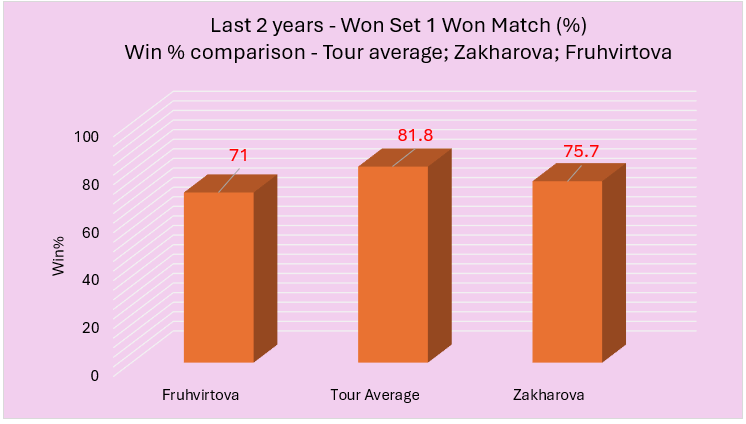
Hence, laying the winner of the first set would clearly be an option. Both players also had very poor numbers when it came to serving out to win a set:
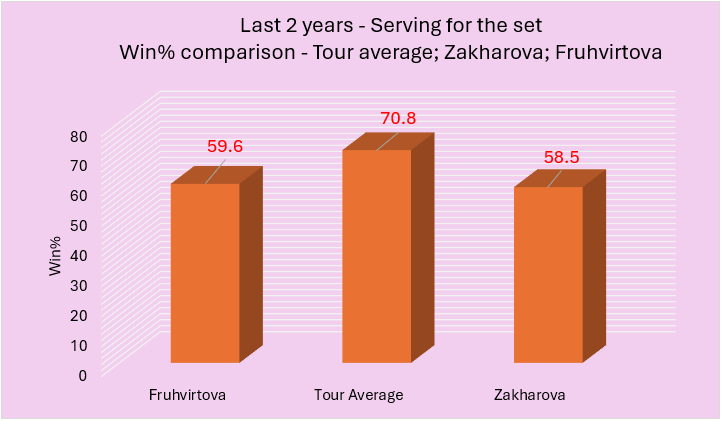
So, I had a second potential ‘in’.
The first set was somewhat crazy with Zakharova breaking Fruhvirtova in her first three service games to lead 5-0. At this point, even with Zakharova having poor ‘serving out for the set’ stats I could see no point entering the market. If there was a game market with good liquidity then laying Zakharova to lose her next service game would have been a play, depending on the odds, but individual game markets rarely have good liquidity even in the biggest Grand Slam matches. The law of sod occurred as Zakharova lost her serve and then Fruhvirtova held for 2-5. Zakharova lost her serve again and eventually found herself serving for the set once again at 5-4. This looked a prime time to enter the market – a 5-0 lead had been squandered as well as five set points coming and going. Not only that, Fruhvirtova had just held to love to bring it back to 4-5. Now, because I have seen so many weird sets of women’s tennis, my ‘spidey senses’ were telling me not to enter the market. Fortunately, I was right as Zakharova amazingly held to love to take the set.
At this point, I had no compunction to trade early in the second set despite having the ‘lay the first set winner’ as a viable option based on the previous stats I shared. I was going to wait until the end of the set hoping that either one would be trying to serve out with a solitary break of serve at the time.
The set panned out with that exact scenario. Zakharova was 5-4 up, serving for the match and available to lay at 1.09 so I took the following position.

The reason I like these scenarios is because there is always a much bigger upside than downside. My 200-unit stake meant an effective outlay of 18 units. Zakharova duly lost the first two points to go 0-30 and suddenly she was 1.21 to back, 1.22 to lay. The price swing was a little higher at this point than I had expected, probably three or four ‘ticks’, so I decided to go back in and semi hedge:

This essentially gave me a non-losing position at this point and the plan was to back Zakharova and green up if indeed Fruhvirtova broke serve. It then went 0-40 and it looked like everything was going to pan out as planned, but Zakharova saved three consecutive break points bringing it back to deuce. Her price was now around 1.09 to back, 1.10 to lay. I made a quick decision to let the software ‘green me up’:

If I had waited for the end of the game, it would have given me a much bigger profit as Zakharova was broken and her price hit close to 1.30. However, a profit is a profit and we move on.
I had staked more on that match than the Boulter one and made a similar profit, but of course a much smaller return.
Wednesday 4th March 2026
One match on the Wednesday caught my eye and that was Paula Badosa versus Yulia Putintseva. The reasons I was keen on this one were twofold. Firstly, Badosa has an outstanding 2-year record when losing the first set, and secondly Putintseva can often get frustrated if matches turn against her or she is struggling.
Badosa v Putintseva
The ideal scenario occurred with Putintseva winning the first set. It was quite a close set with Badosa breaking serve once and having three more break point chances in the seventh game.
Ultimately those chances were not taken but with Badosa serving first in the second set I felt this was the time to enter the market. If she could hold her serve and put pressure on Putintseva’s first service game of the set, I could see the price swinging nicely in my favour.
I placed a 33 unit lay on Putintseva at 1.60 which equated to a 19.8 unit outlay. This entry point proved to be the wrong call as Badosa immediately lost serve. I was now in a slight quandary whether to take the hit now or see if Badosa could put pressure on Putintseva’s next service game. I decided to wait, a mistake as it turned out. I bailed out when Putintseva was a skinny 1.14 to back. Hence, the software instigated a bet on Putintseva of 46.31 units at 1.14 giving me a loss of 13.13 units.

A short and sweet painful loss. There were other matches that day I had kept an eye on, but nothing appealed enough for another trade.
Friday 6th March 2026
No trading for me on the Thursday, so I headed into Friday when some of the big names entered the fray including Aryna Sabalenka and Coco Gauff.
Raducanu v Zakharova
Having traded successfully on Zakharova earlier in the week, it made sense to try and understand how this game might go. Another reason for potentially trading this one was simply because I have watched so many Raducanu matches I think I have a good feel for how she is playing. There are certain things to look out for when watching the first few games of a Raducanu match, although I’m sorry, I won’t be sharing those insights here!
Raducanu is nearly 9% above the tour average when it comes to breaking first in a match and my expectation was that she would probably break first and likely take the first set. From there, my aim was to look for an entry point laying Raducanu at very short odds. The match panned out as expected. Raducanu was very impressive in the first set winning it 6-1. Zakharova was by no means a by-stander in that set, hitting some quality shots of her own. Raducanu led by a set and a break at 3-2 where her price to lay was short enough to enter.

I effectively had a downside of 18 units at this point.
One reason I entered now was that the balls were starting to get older and fluff up which can affect Raducanu’s ability to hit through the court. She had been serving really well, but my instincts were right, at least for the first part of the sixth game where Zakharova took three of the first four points to have two break points at 15-40. I decided to re-enter the market now as before this game Raducanu had only dropped eight points in six service games and I felt that it was not a given that she would be broken. Her price had doubled leaving a quick and tidy profit anyway.

A profit on the bet of 16.07 units before commission which equated to the following:
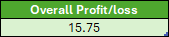
Raducanu did hold in the end, so my instinct proved correct this time. She went on to win the match 6-1, 6-3.
Cristian v Joint
Cristian does not tend to start matches well with her first set win record over 8% below the tour average over the past two years, and both years she has posted very similar percentages. The graph below shows the five lowest win percentages from players currently in the top 50.
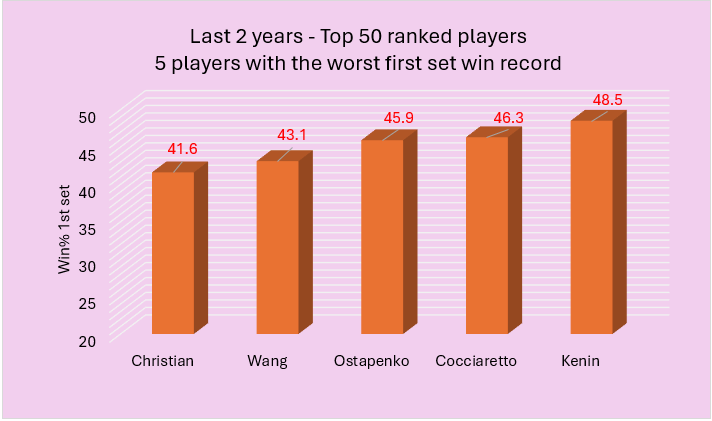
Her 2-year percentage is the worst of anyone currently in the top 50.
In contrast, when losing the first set Cristian’s stats for winning the second set and levelling the match is just above the tour average. Not only that, when losing the first set she has broken first in the second over 48% of the time which is a huge 12% above the tour average.
My play then was to back Joint pre match with a view to trading at the end of the first set / early in the second.

The first game saw Joint save three break points before holding, and she then broke for 2-0 and held again for a 3-0 lead. I decided to lay off my stake at this point with a view to re-entering the market at the end of the set, assuming/hoping that Joint would win it.

The first set actually flew by with Joint eventually winning it 6-0. I decided to green up and take stock. The software instigated a 3.15 unit bet on Cristian at 4.3 and after commission my situation was currently:

One thought I had at this point was to put all my current profit on Cristian to win based on her second set figures for breaking first in set two having lost the first. If she broke, then I could green up and increase my profit somewhat. However, I decided against it because the first set had been so one-sided. I switched the PC off and went to bed.
Next morning, I checked the result to see that Cristian had broken first in the second set and, not only that, she also went on to win the second set and the match as well! Although I did not ultimately profit further in this match from some strong stats I noticed pre-match, at least it showed that the data on tennisprofits.com have give us a genuine long term edge.
**
To conclude, this was a very good week with four winning matches from five, and one match a no play. So, an 80% success rate. Looking at my stats, my long-term success rate is quite a long way down from that on 57.9%.
My takeaway was that when I trade, I need to fully commit and focus on it, like I had done this week. Normally, when I am fitting the trading in between other things I am less prepared. It definitely makes a difference when I am able to fully research matches beforehand and, being honest, there have been too many times in the past when this has not happened. Will I be able to improve upon my long term 57.9% figure if I fully commit more in the future? Hopefully.
I think I need to reconsider my yearly trading timetable as it were, and how I can fit things better around my other commitments. Trading is never going to be a full-time occupation for me, but if I could be more effective when I do trade then clearly it will be more lucrative. Perhaps that advice is something you can think about, too?
Until next time…
– DR


Really interesting read, thanks.
Great stuff Dave.