
 The New Season – focusing on the WTA
As I pen this piece, there is a week to the start of the new WTA season, writes Dave Renham. The first couple of weeks in January will see the United Cup take place as well as two WTA 500 events in Brisbane and Adelaide, and a pair of WTA 250s in Auckland and Hobart. As ever, it will be interesting to note which players hit the ground running.
Of course, the highlight of the early part of the season is the first Grand Slam of the year in Australia. The main draw gets underway on Sunday 18th January but, before that, qualifying begins on the 12th January. The qualifying tournament will have British interest with former British number one Katie Boulter lining up. Boulter had a torrid 2025, starting the year ranked 24 in the world and finishing outside of the top 100, at 106. She had a foot injury in February that set her back which meant she missed two big WTA 1000 events in Doha and Dubai where decent ranking points were on offer. However, it was on the American hardcourt swing that it really went wrong. Still ranked 41 when she lined up at Washington in July, she managed just one win in five tournaments culminating with a first-round loss in the US Open to Marta Kostyuk. It will be very interesting to see how she starts this season.
The main focus of this post is a detailed review of the strengths and weaknesses of three players with a view to trading them in matches in 2026. I will also flag three other players in a bit less detail. It is very important to appreciate that, regardless of your views of players – and potential trading angles to use for them – not every match sees them play the same; so for each individual player it is not a case of one cap fits all. In addition, the player on the other side of the court will always have a bearing on how the match should be traded.
Coco Gauff
Incredibly, American superstar Coco Gauff is still only 21 years old! She has two Slam titles to her name (2023 US Open, 2025 French Open), three WTA 1000s, and she won the Tour Finals in 2024. She has peaked at number two in the world and for the last three years ended the year as World number three. Gauff has many attributes which make her a great player – she is extremely athletic, mobile and quick around the court; she has a world class backhand, and she has a strong and powerful first serve. Her forehand has caused her problems in the past, but it is more solid currently than a few years back.
Her main issue has been second serve and how often she double faults. She served 422 double faults in 2025, which was 122 ahead of the next highest in the top 100 players. Of course, she does play a lot, so the overall number is not perhaps the best guide, but if we look at her double fault rate in 2025, it stands at 10% which again is the highest out of all the top 100 players. Also, 2025 was not a one-off as she had the highest double fault rate in 2024, too.
The graph below compares Gauff with the rest of the top ten in terms of percentage rate of double faults over the 2025 season:
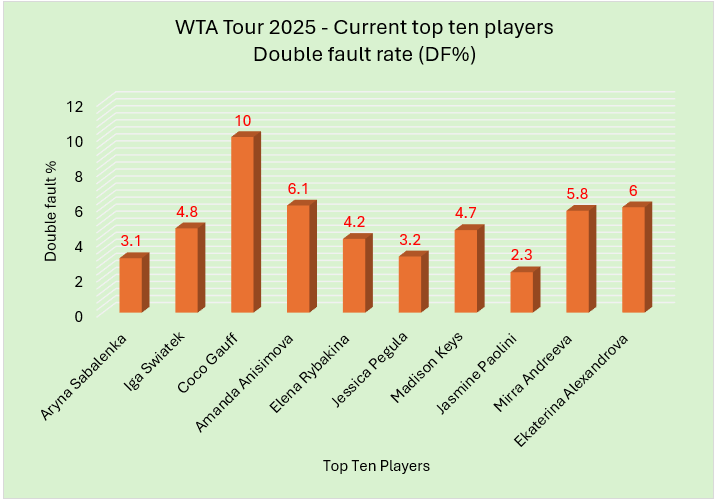
Six of the top eight have percentages under five, so we can see that this is a big problem for Gauff. Just before the 2025 US Open Gauff hired a dedicated serve coach in an attempt to solve the problem. The jury is still out on whether the weakness is on the road to being fixed, but the final months of last season still saw a high percentage of double faults being served. Clearly, this will be a work in progress, but a trading point of view it should give us a few potential ‘ins’ this coming season.
When Gauff has served more double faults, or a higher percentage of double faults to be precise, it definitely has affected her overall performance. Yes, she is losing a few extra points due to these doubles but, in general, over a long match this should not be enough on its own to change the course of the final result (unless of course she is serving a ridiculously high percentage of double faults).
If we look at matches in 2025 where her DF% was 12% or higher across the match, she won ten of those 18 matches (win rate 55.6%); when the DF% was under 7%, she won 16 of 18 matches (win rate 88.9%). Hence, when I am watching a Gauff match with the option of trading it at some point I will be looking very carefully at how her second serve is holding up early on.
One experiment that I have conducted regarding Gauff is to compare how often she double faults on Pressure Points versus Non-Pressure Points. I have not found a quick way to do this so my data is a little limited, but I have looked at ten of her matches in 2025. I chose a mixture of matches, but most of them were from August onwards, and most were against top ten players (eight of the ten to be precise). Obviously, Gauff has gone deep in many tournaments so she often has faced the top players at some point. For the record, I didn’t check the match DF% rate before choosing the matches as I did not want to be influenced in any way.
Just a reminder for those who may not have read a previous article of mine regarding Pressure Points. These refer to moments when the server faces a real threat of losing their serve. This includes defending breakpoints, as well as moments where losing the next point would see the server having to defend a breakpoint. There are eight such scorelines 0-30, 15-30, 0-40, 30-30, 15-40, 30-40, 40-40 (deuce), and 40-A. In the Gauff data crunching I have also included Pressure Points in tie breaks using the same criteria.
The graph below shows Gauff’s DF% rate in these ten matches comparing Pressure Points (PP) to Non-Pressure Points:
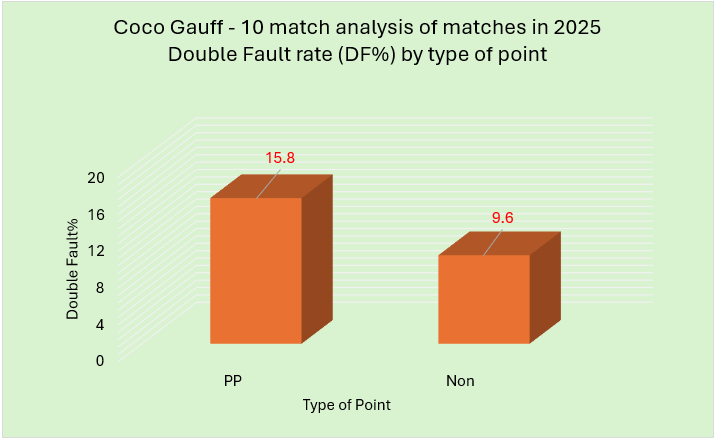
The figures from this snapshot of matches clearly show that Gauff has double faulted far more when facing pressure on her serve compared with when there is little or no pressure. This is a significant difference when taken in context. In effect, across these ten matches, she has been 65% more likely to double fault on a Pressure Point compared to a Non-Pressure Point.
Now, I appreciate that this sample was relatively small in the grand scheme of things, but it did include over 730 of Gauff’s service points. Hence, I am fairly confident that over a longer timeframe we would see a similar pattern. Therefore, as traders, when Gauff misses her first serve on a pressure point, this could be a good time to enter the market.
Emma Raducanu
I am sure British tennis fans still cannot quite believe that Emma Raducanu won the 2021 US Open, but she did, and she won it well. Yes, the cards fell in her direction in terms of avoiding the very best players but she was a qualifier who won a Grand Slam, winning ten matches without dropping a set. I think one of the main reasons Raducanu played so well in that tournament was down to the tennis balls. They were lighter that year (as they were in 2022 as well), which caused complaints from some of the top players. It suited her game and she was able to control them better than certain top ten players at the time, namely Barty, Osaka, Swiatek, Muguruza and Kvitova.
For anyone who is dismissive of Raducanu’s ability, or indeed work ethic, they are sorely mistaken. At her best, she can mix it with the top players in the game. We only have to watch her two matches last year with world number 1 Aryna Sabalenka at Wimbledon and Cincinnati to know that. Her two main issues are maintaining her best level for long enough, and her body in terms of keeping fit and injury free. From a trading perspective, though, these two factors could have easily worked in our favour last year, not just once or twice, but several times. One example that is clear in my mind because I was actually watching courtside, was her last 16 match at Queens against Rebecca Sramkova. Raducanu raced out to a 5-0 lead in the first set and had two sets points for a 6-0 bagel at 40-15 on her serve, but roll forward 15 minutes and Sramkova had broken her twice and suddenly it was 5-4. I was keeping an eye on the first set market during that set, and anyone trading that set could have made a significant return.
The fitness issue raised its head a couple of times later in the year when she squandered match points in the second set, first in Seoul, and then just 11 days later in Beijing. In Seoul she led Barbora Krejcikova 5-2 in the second set having won the first. She saw three match points come and go, one in the 9th game and two in the tie-break. In the deciding set she collapsed physically (and possibly mentally), losing it 6-1. In Beijing against Jessica Pegula, Raducanu again led by a set and break and again had three match points that she failed to convert. The final set again was incredibly one-sided with Pegula winning it to love.
It should be noted that Raducanu has the capacity to do to others what they have done to her, as she came back from a set and a break down at Eastbourne to beat Ann Li. Also, on her least favoured surface – clay – in Rome she came back from a set down to Veronika Kudermetova to steamroller her opponent in sets two and three 6-0, 6-1.
Overall, though, in 2025 Raducanu’s third and deciding set record was poor: just five wins from 14 (35.7%). Raducanu’s third set win percentage was the lowest of all of the top 30 players. Indeed, 15 of the remaining 29 had final set win percentages of 55% or higher. I think Raducanu will continue to offer decent trading opportunities as we move into the new season especially when the match goes deep into the second set / third set.
WTA Top Ten Players’ Deciding Set Win Percentage
Before moving on, below is a graph showing the performance in terms of win percentage of the top ten players in third sets in 2025:
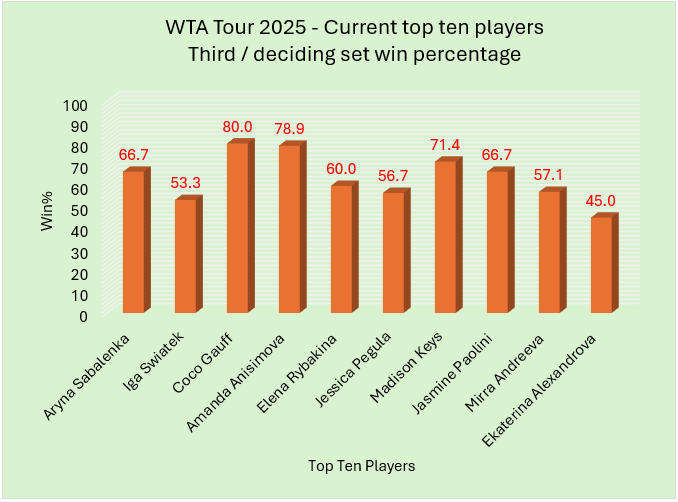
There are, naturally, some very high figures with Coco Gauff heading the way on 80% (12 wins, 3 losses). Despite her second serve issues, Gauff has been formidable in final sets. Amanda Anisimova was a close second on 78.9% (15 wins, 4 losses). Nine of the ten had figures about the 50% mark.
Daria Kasatkina
Daria Kasatkina is a player I believe is one of the best to trade, because she has a weak serve but an excellent returning game. Hence, her matches will generally have numerous fluctuations giving us opportunities to back and lay several times in a match. Obviously, we are not guaranteed to always choose the right time to enter the market, but understanding her strengths and weaknesses, as well as the relevant percentages, will improve our chances of making good choices.
She had a poorish 2025, dropping from number nine in the world at the start of the year to 37 at the end. However, 2025 was a big time in her life, switching from Russian citizenship to Australian, which I am guessing took its toll a bit on her game. She also ended her season early citing mental and physical fatigue from the rigours of the Tour.
Going back to her strengths and weaknesses when we take a deep dive into her serve stats in 2025, we can see the following:
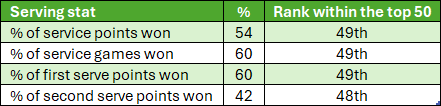
As the table indicates, in 2025 Kasatkina had some of the worst serving stats within the top 100 players. This year was not a one-off either; in 2024, despite ending the year in the top 10, she was ranked 45 for service points won, 44 for service games won, 45 for first serves won and 48 for second serves won.
Compare this though, to her returning stats:
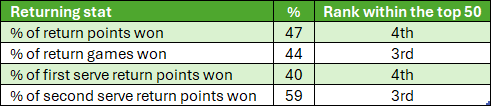
In 2024 she ranked 6, 5, 7, 8 for those return metrics so, like the serving stats, 2025 was no one-off.
As a tennis fan I hope Kasatkina comes back fresh and happy in 2026. She is an interesting player to watch without the power of the top players, but she has the finesse and skills of a lost generation of players. She also should give us excellent trading opportunities.
Linda Noskova
Currently ranked 13, Czech player Linda Noskova is another player who has struggled on opponent’s serve. In 2025 she was ranked worst (50th) out of the top 50 for breaks of serve (% of return games won), and 50 for % of return points won. Again, as with Kasatkina, last year was not a one-off as she ranked 98 and 99 in the top 100 respectively in those categories in 2024.
Her break of service percentage against top 20 players is down in the bottom five at just 22%, and in 2024 it was even lower at 20.9%. I would be against taking a positive position on Noskova on return.
Emiliana Arango
Perhaps an unfamiliar name to some, but Arango is ranked 49 in the world after a strong 2025. From a trading perspective she could offer some excellent opportunities as her serve is probably the weakest of the top 50. Her service hold percentage was just 54.2% in 2025, the lowest by nearly 6%! She was also broken over 52% of the time in her first service game, the worst figure for the top 50 players so laying her pre-first service game looks a solid potential option.
Not only that, but in first sets when she was broken in 2025, she broke back 65.9% of the time – the eighth best in the top 50 – exactly what traders are looking for. Also, when Arango broke her opponent’s serve, 45.1% of the time she lost her serve in the very next game. This looks like another potential ‘in’. It should be noted that on clay this 45.1% figure rose to a huge 58.8%.
Anna Bondar
For those who read my very first article for tennis profits, I discussed Anna Bondar as she can be the perfect player to trade. I don’t want to spend too much time going over old ground but her performance in matches can fluctuate wildly. I suggest a read of this article if you haven’t done so. For those who did but may have forgotten the meat and bones, it may also be worth a re-read.
**
I am a strong believer in specialising when it comes to betting or trading. I write regular horse racing pieces for www.geegeez.co.uk and my personal approach to horse racing betting / trading is to specialise in specific types of races. Getting to know those types of races and the horses that run in them as well as I can. My feeling is that if we don’t specialise, it is easy to spread our time too thinly. Likewise in tennis, having a few key players that we know ‘inside out’ is something I think is important. The more we watch these players – and, with Tennis Profits, dive into their statistic performance – the more we will understand their strengths and weaknesses, and the better ‘feel’ we can have for when is the right time to enter or leave a trade.
– DR


As always, a fascinating read and now has me looking forward in anticipation to the start of the new Tennis season ! Thanks
Thanks Jonathan.
Today we saw some classic Raducanu – went to three sets and lost the final set badly 6-1; and some classic Gauff – 14 double faults in her match which she lost to a player ranked 38 places below her.
Dave
Arango played in Hobart the other day against Ruzic – lost her first service game again. She fought back to lead 5-3 in the first set and traded at 1.14 on the first set win market before losing her serve twice to lose the set 7-5.