 WTA Clay Court Season 2026
This is a companion piece to my ‘Looking forward to the Clay Court Season’ piece penned recently, writes Dave Renham. In that one, which you can read here, I focused on the ATP Tour whereas in this one I will be previewing the WTA – women’s – tour.
The first two WTA clay-court tournaments have started – a 500 in Charleston, USA, and a 250 in Bogota, Columbia. After these, the main clay court tournaments (WTA 500 / 1000 events) will be hosted in Europe and they are shown below:

Following Strasbourg at the end of May, the second Grand Slam of the year, the French Open at Roland Garros, will begin. In this article I am going to examine the last two years’ worth of WTA clay court stats to try to give us an edge regardless of whether we are betting or trading.
Overall WTA Stats: Clay vs Hard
In the previous ATP clay article, I observed that there are some players who are better suited to clay courts than hard courts, and vice versa. I also noted that clay courts play differently to other surfaces in that they tend to be slower, the bounce is higher and therefore rallies last longer. It is harder to hold serve on clay so there are more breaks and thus more chances of odds swings. More odds swings should mean more trading opportunities.
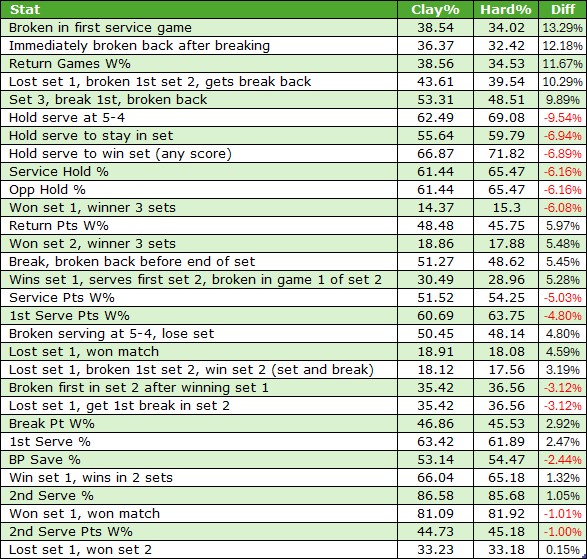
Below are the 2-year key stats on the main WTA Tour comparing the clay court numbers with the hard-court ones. I have ordered them so that the stats at the top see the biggest percentage change between the surfaces – see the ‘Diff’ column:
Broken in 1st Service Game
When looking at the ATP stats one of the biggest differences between hard and clay was around holding serve in the first service game of the match. This stat on the WTA has seen the biggest change in percentage terms.
On hard courts, WTA players were broken 34% of the time in their first service game of the match; on clay this increased to 38.5%. As we would expect there are a handful of current top 100 players that were broken far more often than the clay 2-year average in their first service game. The most notable of these players were:

We might want to consider placing an early lay on any of these players just before their first service game, especially if they are playing a stronger opponent or a much stronger server.
Conversely, there were a group of players who had strong stats with percentages well below the average in terms of winning their first service game of the match. Those with the best 2-year clay stats in terms of holding their first service game of the match were:
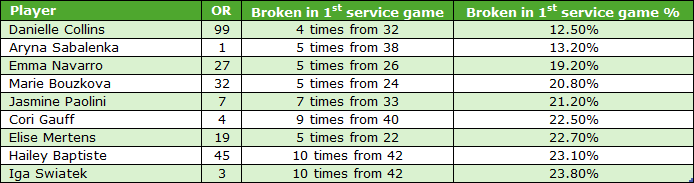
No surprises to see four of the top ten in there including current world number one Aryna Sabalenka. It should be noted that Danielle Collins, who had the best 2-year figures, is currently injured and I am not sure when she is expected back on the court. She has yet to play in 2026 which helps explain why her world ranking is currently 120.
Immediately broken back after breaking
Another stat with a significant percentage change from hard courts to clay is the ‘immediately broken back after breaking’ stat. The WTA average increases from 32.4% on hard courts to 36.4% on clay. We again have a few players who really struggled to hold serve after breaking their opponent’s serve the previous game. These players were:

For tennis traders, this is exactly the type of stat we can take advantage of. Knowing that this group of players seem to have a weakness backing up a break of serve gives us a potential ‘in’. This is especially true if their opponent has better than average return of serve stats.
Individual Players: WTA Top 3
I want to now switch it up a little and focus on the three best players on the surface based on performances in the past two years as, almost certainly, they will be playing the most matches over the next couple of months.
Aryna Sabalenka
Sabalenka has started the year extremely strongly despite losing the Australian Open final. She has played in three other tournaments winning all three – Brisbane, Indian Wells and Miami. She is currently 23 and 1 for the season. So, she comes into the clay court swing in about as good a form as she has ever been.
Her career stats see a higher winning percentage on hard courts than clay courts but there has been only a small margin (2.4%) between them. Indeed, her clay court record in the past three years has been as good as her hard-court record. Her annual win percentages for the last three years are shown in the graph below:

Last year she won Madrid and reached the final of the French Open on her way to winning 17 of her 20 clay court matches. In her other two tournaments she lost in the Stuttgart final and in the quarter finals in Rome.
In the last two years on clay her individual percentages put her within the top five players on tour for the following metrics:

The three highlighted in red are stats where she is number 1 (or joint number 1). Sabalenka will be a huge force on clay again this year, unless she gets injured or suffers a significant drop in level.
Iga Swiatek
If Sabalenka is excellent on clay, and she is, then Swiatek at her best is on a different level. The problem for Swiatek is that her top level has been missing for a year or so now; not just on the clay, but on hard courts also.
The reason for this, in my opinion, was letting her coach Tomasz Wiktorowski go at the end of the 2024 season. The numbers back this up because in 2022, 2023 and 2024, Swiatek’s win rate across all surfaces in each individual year was 85% or higher! In 2025 this dropped to 78.5% and this year currently it’s down at 66.7%. She has recently parted company with her latest coach, which I think is the right decision based on those numbers.
Back to her clay court record and, since 2020, it has been quite exceptional:

These are verging on Nadal type figures and the most recent annual splits from 2022 to 2025 are shown below:
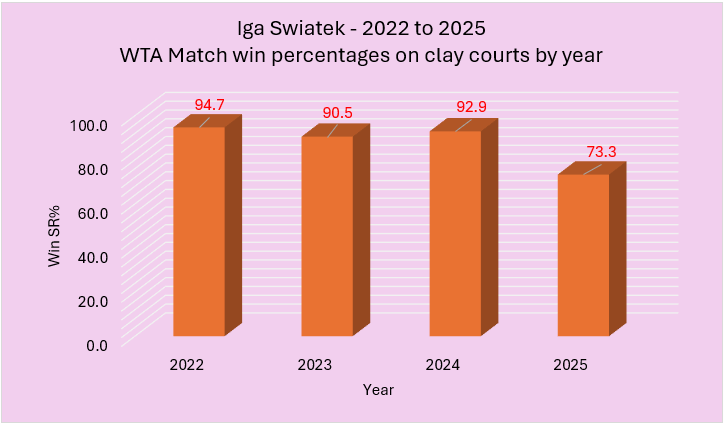
This graph perfectly highlights two points I’ve previously made, namely her astonishing clay figures during her peak (2022-2024) and the downturn in fortunes since parting with Wiktorowski (2025).
Clearly, it is impossible to know exactly how the 2026 clay court swing will go for the Polish player. However, betting firms are erring on the side of caution as they all have her favourite for the French Open, at the time of writing.
When looking at Sabalenka earlier I shared the individual 2-year clay court metrics that put her within the top five players on the WTA tour. Below are the metrics where Swiatek made the top five. Once more, those in red indicate that she had the best percentage of any WTA player:

Remember, these include her modest (by her own standards) 2025 stats and yet she still found herself in the top five of all tour players for nine metrics, four of which where she was top or joint top. If Swiatek regains her confidence and form, then she will still be the player to beat on this surface.
Coco Gauff
Gauff was last year’s French Open winner, and she heads our TP Surface Rankings for clay. Clay has been her best surface over the years with an all time win rate of 75.3% compared with just over 70% on hard and 64% on grass. The 2026 season to date, however, has not seen her at her very best, with a few frailties creeping into her game from time to time. Having said that, she has still only lost six matches out of 22 and she reached the final of Miami a few days ago before losing a tight three-setter to Sabalenka.
For Gauff, and I have mentioned this before in previous pieces, it is her serve that can be her Achilles heel. The curse of the double fault rears its head regularly, and when that has been the case in 2026 it has been a struggle. It is testament to her all-round game that she has still managed to win matches even when her double fault rate has exceeded 15%. That excessive 15%+ DF rate has occurred four times already this year, but she has managed to win three of those matches.
Last year on clay she had 18 wins and just three losses and, overall, her serve held up well. In only 28% of these matches did her DF rate exceed 10%; compare that to this year however, where a 10%+ DF rate has occurred in exactly 50% of her matches. In Miami, though, where as mentioned earlier she reached the final, the 10%+ DF rate happened only once in her six matches. Hence, there seems a correlation between fewer double faults and better performance. As a trader, if Gauff hits a couple of early doubles there may be opportunities to lay her, especially when she is playing one of the top players.
Here are the strongest Gauff clay stats from the last two seasons – those where she appears in the top five of all WTA players. Again, as before, if Gauff had the best percentage of any WTA player it will be shown in red:

Gauff, Swiatek and Sabalenka are the most likely players to be making clay court finals and potentially winning titles this year.
Of the remaining players, Elena Rybakina – who has been in fine form on the hard courts – cannot be discounted but her best clay level in the past has been marginally below the three mentioned. Rybakina topped the 2024/25 WTA clay court percentages for winning the first set at 84.6%, Service holds at 79.3% and Break points saved at 64.3%.
I am also expecting Elina Svitolina to continue her good 2026. Her 2-year clay court stats show that she has been excellent after being broken in a set. Her rate for getting the break back is 80.6% which lies second on the WTA list.
Finally, Mirra Andreeva is another who seems to like the surface. She is still very young with plenty of scope to improve. Over the last two years she has performed well in converting break points, lying 5th in the WTA list.
*
I’m excited for the European clay court swing, and hopefully, across these two clay court articles we have plenty of ammunition to help us trade or bet more successfully in the coming months.
– DR