 Looking forward to the Clay Court Season
This is my favourite time of the year for many reasons, writes Dave Renham. Firstly, there is usually an uptick in the weather and secondly, we have longer days with lighter evenings. There is also hope that the upcoming summer will be a warm and glorious one, although that, as we know, does not always come to fruition, here in the UK at least.
My third reason for loving this time of the year is that it is the start of the clay court season. All the clay court tournaments starting in April and May are held in Europe which is great for traders and bettors as the matches are at normal times during the day. As mentioned in a previous article, I am not a fan of trading late at night or early in the morning. In addition, of all the surfaces, clay courts I feel offer the best trading opportunities.
So, what do we have coming up over the next two months?
Well, the men have three 1000 events and three 500s; the women two 1000 tournaments and four 500s. There is also a sprinkling of 250s as well.
The main clay court tournaments (500 / 1000 events) with dates are shown in the table below. Men’s tournaments are in black, ladies in red.
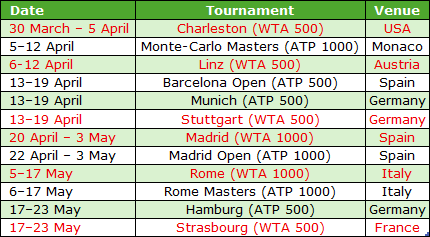
As can be seen, there is plenty to get our teeth into over the next two months, and at the end of May the second Grand Slam of the year, the French Open at Roland Garros, will begin.
In this article I am going to examine the last two years’ worth of clay court stats to try to give us an edge whether we are betting or trading.
With the majority of tournaments each year being played on hard courts, as bettors and traders we need to be aware that clay court tennis has subtle differences to hard court tennis.
The most obvious difference is that clay courts tend to be slower, with the ball bouncing higher and hence rallies last longer. It is harder to hold serve both for men and women due to the slower surface, meaning fewer aces and ‘free points’ on serve.
It makes sense therefore that there are some players who are better suited to clay courts than hard courts, and vice versa; again this is vital information that we need to be aware of.
The most obvious example of this in the last twenty years was the ‘King of Clay’ Rafeal Nadal. Nadal won 14 French Opens, 49 other clay court titles, and enjoyed a career clay court match win percentage of 90.4%. I personally think that peak Nadal on clay was just about unbeatable.
He was of course extremely good on hard courts too, with six Grand Slams and 19 other tour wins; but on hard courts peak Nadal was beatable, albeit rarely. Of course, anyone who knows anything about tennis would have known this, but there are some current players who definitely favour the clay and some others who definitely do not! In what follows, aim to highlight some of these players.
Earlier, I touched upon the fact that it is harder to hold serve both for men and women on clay. The graph below helps illustrates this fact. It compares the service hold percentages for men and women on clays courts compared with hard courts:
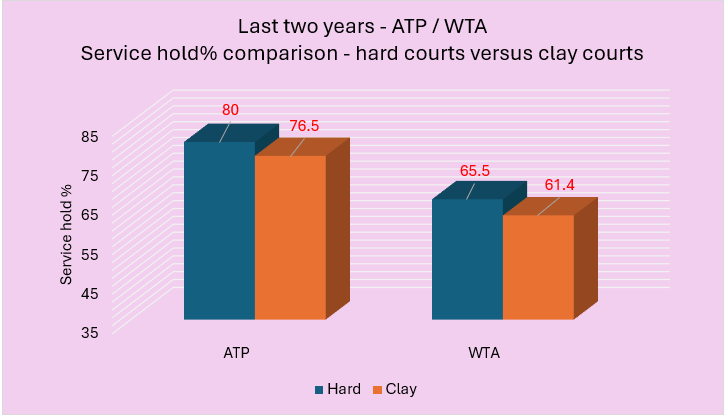
Male players have held serve 3.5% less often on clay than they have on hard in the last two years, women held on clay 4.1% less often.
However, there are further service stats that we need to be aware of. These are shown in the table below:

These stats are illuminating: in terms of points won on first serve, on clay, both men and women have significantly lower percentages. However, on second serve, the percentages between the surfaces are much closer. As a trader, in certain instances I enter the market when a first serve has been missed. On clay, when circumstances are similar, I perhaps should be entering the market before the first serve.
With most of my previous articles looking at the women’s game, in this piece I will be focusing on the men’s tour, beginning with another stat that shows a significant difference between clay and hard court numbers: the percentage of ATP players that get broken in their first service game.
The graph below compares the overall 2-year percentages for hard versus clay:
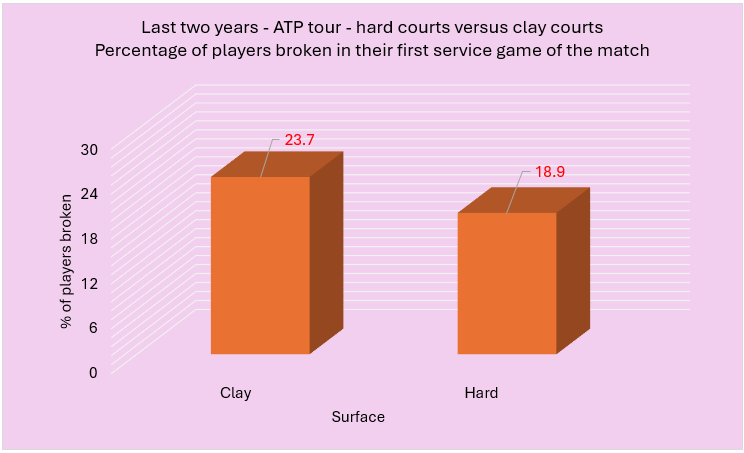
As the graph shows, more players lose their first service game of the match on clay compared to when playing on hard courts.
These numbers equate to a percentage change from hard to clay of around 25%, which is huge – a really significant difference. Moreover, there are a handful of current top 100 players that have been broken far more often than the clay 2-year average in their first service game. These players are:

With these four players we might want to consider placing an early lay just before their first service game. Even if they win that service game our position will still be completely manageable. It would obviously become slightly problematic if any of these four served first, held, and then broke their opponent’s serve in the next game. Having said that, Sonego, Shevchenko and Borges have poor first set winning stats, too, which offers more hope in terms of taking that early market position.
Conversely, there are a handful of players who have very strong percentages when it comes to winning their first service game of the match. Those with the strongest 2-year clay stats are:

Hurkacz, Shelton and Popyrin are renowned strong servers so no surprises perhaps to see those three make this list. Sinner, of course, is an excellent server coupled with having a great all-court game.
If either Korda, Sonego, Shevchenko or Borges meet any of these six this clay court season, then based on these figures a statistically sound play would be to lay pre-match those mentioned weak first service game players in the hope of a quick and successful trade.
Another statistic that has a significant difference between hard and clay court numbers is the percentage of players immediately broken back after breaking themselves. I guess this should come as no surprise based on the fact that there are more breaks of serve in clay court matches than in hard court ones. Here is the breakdown:
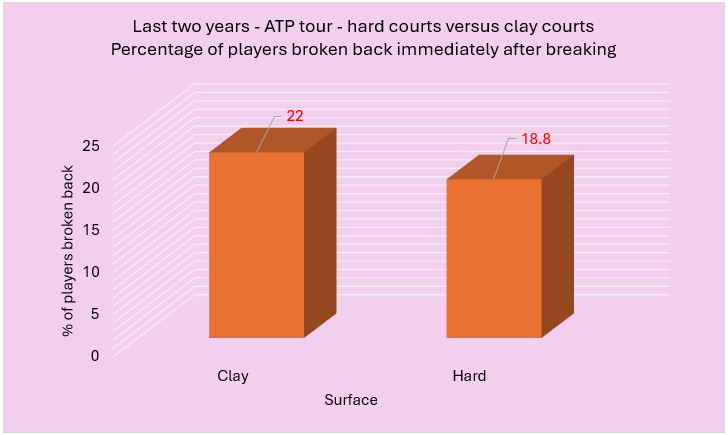
These numbers equate to a relative percentage change from hard to clay of just over 17%. Again, that is a highly significant difference and needs to be factored in when trading clay court matches.
There are four players about whom we should be especially wise to the fact that when breaking their opponent’s serve, they have been broken back immediately far more often than the average in the last two years.
They are Alex Michelsen (36.1%), Rinky Hijikata (34.5%), Camilo Ugo Carabelli (31.5%) and Alejandro Davidovich Fokina (30.7%). All of these percentages are based on a decent individual subset of data, so I will personally be watching their matches carefully this spring and considering a lay bet if they break serve.
I have shared two stats above which have seen a noticeable difference between their hard and clay court percentages. In the table below are all of the key stats from tennisprofits.com, comparing the clay court numbers with the hard-court ones:
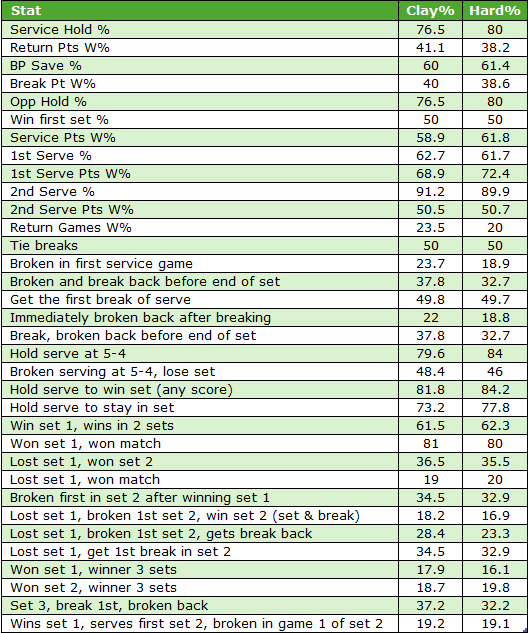
These stats have been taken from the Stats drop down menu on the site using the ’Metrics’ page. This page gives the figures for each individual surface one at a time, so for ease I have copied two pages, linked them together, so it is simpler to compare the two. Also, on that page you’ll find all the WTA stats across different surfaces as well as the Men’s Challenger, Men’s ITF, Women’s Challenger and Women’s ITF figures.
One stat in the table I do want to draw our eye to is the ‘Set 3, break 1st, broken back’ percentages. 37.2% of third sets on clay courts have seen a break back compared with 32.2% on hard courts. For those who like trading third and final sets, clay matches are likely to offer far more price swings later in the match than on other surfaces. Not only that but there should be more matches resulting in significant price swings.
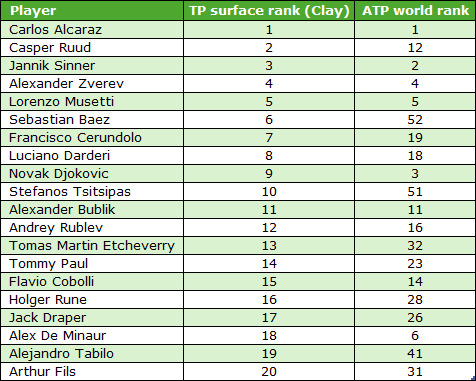
Another useful piece of information that can be found on the tennis profits site is the ‘TP Surface Rank’. This is an algorithm the site uses to work out where players should be ranked when looking solely at their results on a specific surface. This can be extremely useful as it gives us an excellent starting to point for immediately identifying players that are better, or indeed worse, on one surface than others.
Below are the current top 20 TP Surface Rankings for clay courts, alongside the players’ current overall ATP world ranking.
Casper Ruud has long been known as a much better clay-courter than hard, or even grass court, player. To see why he is ranked so high on clay, it makes sense to look at his all-time record across the three main surfaces:
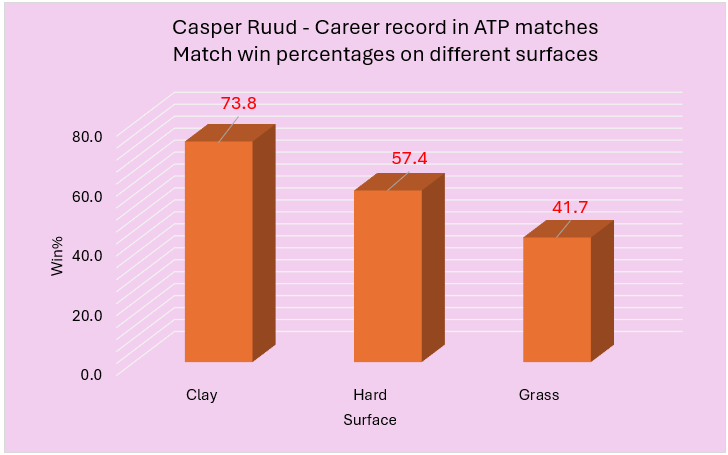
I think the graph explains it all. Sebastian Baez, like Ruud, is far better on this slower surface and his all-time splits are as follows:
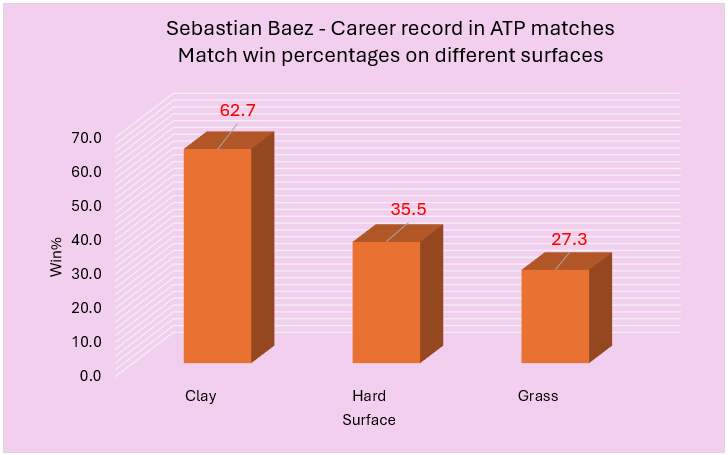
Baez is not far off winning twice as often on clay as he does on hard, which helps explain his TP Clay ranking of 6 compared to his overall ATP world ranking of 52.
Other players to keep an eye on are Francisco Cerundolo, Luciano Darderi, Stefanos Tsitsipas, Tomas Martin Etcheverry and Alejandro Tabilo. All five are much better clay court players than they are on either hard or grass. One small caveat, though, is that the recent form of Stefanos Tsitsipas has been very poor for a player of his ability. Yes, he is better on clay, always has been, but I would not be trading his matches this clay court season until I see definite signs of a resurgence.
In terms of players who are less good on clay compared to hard or grass courts, there are four current top ten players that fall into that category – Alex De Minaur, Taylor Fritz, Felix Auger Aliassime and Ben Shelton. Firstly, let me compare their current ATP world rankings with their TP Clay Rankings:

All four are considerably lower in terms of their clay position. Clearly, the market and most astute traders will know this and hence their starting prices will be higher than they would be in comparable hard-court matches. However, once in play, especially if any of these players start their matches well, their prices will probably contract a little bit more than they should. Hence, trading opportunities should arise from time to time.
Just to give a bit more meat on the bones to why their rankings are so different.
Felix Auger Aliassime’s career stats show a 10% lower win rate on clay compared to both grass and hard.
De Minaur has a 52% career win rate on clay, but it stands at 66% on hard and 64% on grass.
Shelton’s clay court career win percentage stands 10% lower than his hard-court figure, and Fritz played only seven clay court matches last year, of which all bar one were against players outside the top 30. He won just three of the seven (and one of those three wins was when his 62 ranked opponent retired with the score level at one set all). He was also dumped out in the first round of the French Open by 66 ranked Daniel Altmaier in four sets.
*
I hope this article has provided some useful stats from which to attack ATP Tour matches across the clay court season. With more breaks of serve, price swings will happen with greater frequency. However, as ever, we will still need to choose the right time to enter and then exit the market.
Good luck!
- DR