 Looking at how the prices change during a tennis match
The expression ‘there is more than one way to skin a cat’ is familiar to most native English speakers, writes Dave Renham. Essentially it means that there are multiple ways of achieving an outcome. This, of course, is very true for trading tennis. Many traders employ similar strategies but each individual is likely to have subtle differences in how they approach certain match situations.
Some traders are more risk averse than others: they might trade at times in games where wild fluctuations could occur, such as when someone is serving for the match, for example. Others will try and eke out smaller and potentially safer trades earlier in the piece. Within each of these two types of trader we may again see differences in approach.
Some may trade out as soon as their position is green. Some will trade out a percentage in the hope that the match will continue to swing back the way they want it to. Others will hold out longer hoping to increase their potential winnings when they eventually do trade out. There will be a small amount of people who lay or back once and don’t even bother to trade out, in the hope of making a big profit on one game.
There is no ‘right way’ to trade, although of course there are plenty of wrong ways!
I am sure many of us will have chosen the wrong way quite often, especially when learning the ropes at the beginning of our journey. I still make mistakes, fortunately a lot fewer these days; but when I do, it is important, for me at least, to recognise the error and then make the right decision. That normally means trading out for a loss. Take the hit, and move on.
As with anything in life, experience can be a useful ally. With more exposure, we get better at knowing when to enter or leave a market. We get better at reading which path the match is likely to take, at least in the short term. We get better at understanding how prices are likely to move in certain scenarios. In the rest of this article I am going to look at two matches and how the odds moved at certain points.
Before looking at the first match, I think it is important to appreciate that we do not necessarily need competitive matches that go to a deciding set to make money trading tennis. Clearly, matches that go the distance and that also regularly fluctuate back and forth are going to give us the best chance to secure a winning trade or trades. However, matches that seem one sided from a quick look at the result may also have offered good trading opportunities. My first example is a case in point.
20/2/26 – Oeiras (WTA 125) Quarter final – Suzan Lamens v Viktoriya Tomova
This was not a high-profile match by any means, being a lower tier WTA event between Suzan Lamens, ranked 109 in the world, and Viktoriya Tomova, ranked 153. However, by the the time they shook hands after the last shot was hit, £212,787 had been traded in the main match market, so it was certainly high enough profile for trading purposes. If we look at how the match unfolded it is easy to think there would not have been much opportunity to make money on this one.
First set – Lamens broke serve immediately and, after holding for 2-0, broke serve again. She led 5-2 before giving one of the breaks back, then served out the set for 6-4.
Second set – The pattern of this set was similar with Lamens breaking again in games 1 and 3 for a double break and a 3-0 lead. This time, though, one break back for Tomova occurred immediately, to make it 3-1 to Lamens, the latter still a break up. The remaining games went on serve so Lamens took the match by two sets to love, 6-4 6-4.
On the surface, then, this was a comfortable win for Suzan Lamens, but good money could have been made by trading at the right time during the second set.
Let me illustrate this by linking some of the second set scores to Exchange prices that were on offer. Firstly, let us look at the how the third game of the second set went, point by point. Lamens remember had broken in the first game of the second set and held for a 2-0 lead, and hence it was Tomova serving:
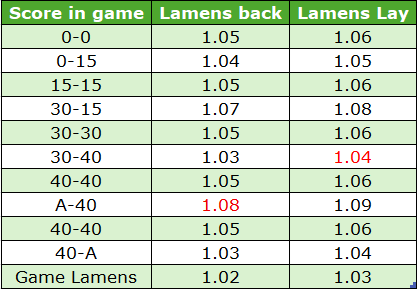
As we can see the game went to two deuces before Lamens got the double break for a 3-0 lead. However, I have highlighted in red potential entry and exit points within the game which would have secured a good trade.
Lamens’ price to lay at 30-40 was 1.04 and she had break point. Tomova won the next two points to get to Advantage and Lamens’ back price was now 1.08. Let’s say we had entered a £500 lay at 1.04 which equates to a liability of £20, we could have quickly ‘greened up’ by backing £481.48 at 1.08. After a 2% commission that would have secured an £18.15 upside on either outcome.
That equates to a yield of 90.8%. For the record, if our commission was 5% then the upside would drop slightly to £17.59 which would have given a yield of 88%.
Now, we need to be quick when going into or out of a market point by point, and there are going to be very few people who would be able to work out that £481.48 was the exact amount needed to green up in this scenario. That is why most serious traders use trading software such as Bet Angel, so we don’t need to make such quick and difficult calculations; the software does it for us.
Of course, assuming we made that first lay at 1.04, there were no guarantees that Tomova would win the next two points and, naturally, Lamens could have won the first of them and secured another break. As we can see, Lamens did eventually break after two deuces and her back price dropped to 1.02.
In this scenario of Lamens winning the next point and breaking after our initial lay we would be looking at a loss due to the likely price drop to 1.02. Trading out for a loss now is what many experienced traders would do – ‘take the hit’ and make sure we do not lose all the original stake. If trading out for a loss at 1.02 we would be looking at a loss of £9.80 rather than losing the whole £20 stake meaning a loss of 49% rather than losing 100% of our stake.
Ultimately, would trading for a loss at this point be the best thing to do? It is difficult to be 100% sure, without mountains of data to dive into. Again, each trader is different and although most will cut and run, if you think there is a very good chance a match might swing back in your favour enough to make a winning trade you can sit and wait. There is a huge potential upside in this example if the match does start to go in the direction you want it to. Sometimes that is hard to resist…
Going back to the Lamens / Tomova match and the fourth game of the second set. Let’s assume we have not traded this match as yet. Lamens, remember, is a double break up at 3-0 and serving. The next game went as follows:

I have highlighted in red the lowest price Lamens was available to lay in this fourth game which was 1.02 when she led 30-15. Ultimately, she lost the game and at that point was available to back at 1.05 (also highlighted in red). Again, a lay at 1.02 would have given a quick and very decent trade out option at 1.05. If risking an initial outlay of £20 again this scenario, (so £1000 lay at 1.02), this would have seen a green up profit of £28 (140% yield).
Of course, if we had put our lay in at 1.02, we might wish to wait a bit longer for a potential trading out opportunity than at the end of the game especially with Tomova serving next. What happened with the prices from here is that Tomova held for 2-3 and won the first point on Lamens’ serve in the sixth game. That was the point when Lamens hit her highest back price of 1.12. From there onwards Lamens got closer and closer to the winning line and her price contracted bit by bit as a result.
If we had chosen the best entry point (lay at 1.02 risking £20) and the best exit point (back at 1.12), we would have secured a profit of £87.50, which is a net yield of 437.5%! That would have been a lovely day at the office. Now, this would have been the best possible outcome and of course much more unlikely to happen in reality than likely. However, my point is that even in matches that are won fairly comfortably, excellent trading opportunities such as this might well occur.
20/2/26 – Dubai (WTA 1000) Semi-final – Amanda Anisimova v Jessica Pegula
This was a much higher profile match being the semi of a WTA 1000 event between the fifth and sixth best players according to the current rankings, Amanda Anisimova and Jessica Pegula. This is the type of match that could offer good trading opportunities with two players of very similar ability playing for a big prize of reaching a top tier final. They had met four times before and Pegula had won all four including a recent win at the Aussie Open. Two of the last three matches had gone to three sets including a tie break final set in Charleston in 2024. Pegula was favourite, not surprising based on their head-to-head and her decent start to the season.
We have seen how prices can fluctuate within a specific service game, in the Lamens match above for example, while for this match I am going to be looking at the prices available at the end of each game seeing game by game price fluctuations as it were. I will share this data set by set.
The prices at the start of the match were:

So, in percentage terms based on these starting prices, Pegula had around a 62% chance of winning and Anisimova just under a 39% chance.
First set – I think most pundits expected this to be close, but the first set was not that close. Anisimova served first and below is a graph showing the ‘back’ price of Pegula at the end of each game in the set. Her lay price was always one ‘tick’ higher.
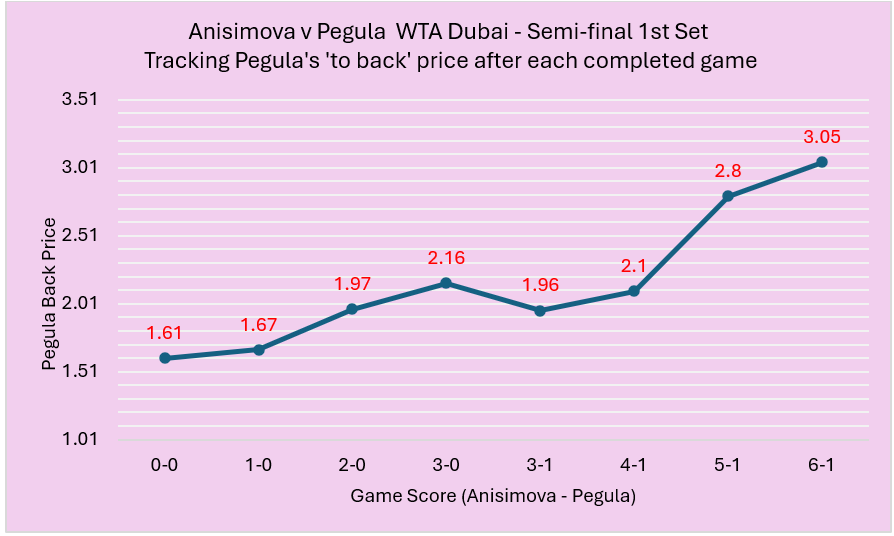
Anisimova was in charge of this set from the get-go, holding serve for 1-0 and then breaking immediately for 2-0. Three holds followed (two for Anisimova and one for Pegula) before Anisimova broke Pegula again in the sixth game to lead 5-1. She held serve to take the set 6-1.
Around 34% of WTA matches go to three sets. This is based on nearly four years’ worth of recent data I have looked at. This percentage drops a little when examining first sets where the scoreline was 6-1, which makes sense. The 3-set figure for 6-1 first sets is around the 29% mark fluctuating most seasons between 27% and 31%. For those traders who often use the ‘lay the first set winner’ strategy, knowing these percentages will be extremely useful as they will give them a guiding hand when deciding whether to enter the market or not.
Looking at the prices on offer, it is interesting that at 4-1 down Pegula’s price to win was 2.1. The likelihood of her pulling the set back at this point would have been unlikely, but of course possible. Her back price when actually losing the set was 3.05 which seems quite a big jump from 2.1. I think the 2.1 price at 4-1 down was a little on the short side; I personally would be pricing it nearer 2.3.
Another factor other than past percentages for traders to consider at the end of this set is to try and determine whether we actually thought Pegula could mount a comeback. Clearly, being world number five, she would be very capable of improving her play in the second set and potentially levelling the match. In terms of digging a bit deeper into the first set, she did put Anisimova under pressure in two of her four service games, taking the first game of the match to deuce, while another service game saw four deuces before Anisimova prevailed.
Onto the second set.
Second set – As before I will be sticking with Pegula’s back price and the graph below will show the price movement from game to game.

This graph in particular highlights why tennis trading is so popular, with several significant price changes between individual games. Not just that, we see the up then down then up then down pattern, too, which in part was due to five breaks of serve out of the ten games played. And of course, we know that within each game there would have been similar price shifts going on. Indeed, after one point of the fifth game Pegula’s price peaked at 8.6 as she went 0-15 on her serve while trailing 3-1.
Pegula’s price at the end of the second set was now almost at the price that she started the match (1.61) as they entered the decider.
Third (final) set – I have one more graph to share which shows how the deciding set unfolded:

So, Pegula held serve dropping to a price of 1.38 and then Anisimova held and the price went back up to 1.57. Two relatively big swings, which is worth noting as two players holding serve at the beginning of the first set would not see such big price movements. Pegula held again for 2-1 (1-2 in graph) but as we can see her price only dropped to 1.45, which on the face of it looks odd given that she had gone 1.38 previously when holding for 1-0 in this set.
Normally, the closer you get to the winning line in a final set after holding serve, your price shortens slightly in comparison to its previous price after a previous hold. But instead of being maybe a couple of ticks lower than 1.38 at say 1.36, the price was seven ticks higher at 1.45. This was due to how the game played out as there were four deuces and hence it was a struggle for Pegula to hold. Therefore, those trading in this market were influenced by this, pushing the price out as a result. However, the market did not make the right call as in the very next game Anisimova was broken, and Pegula went 3-1 up and was suddenly down at a price of 1.18 to win.
This type of break of serve scenario seems to happen quite often. A player pushes hard in a return game but fails to break their opponent’s serve, and that failure seems to drain their confidence and they get broken themselves in the very next game. It’s something that Paul often talks about in his trading videos on site.
The rest of the match was relatively uneventful from a trading perspective as Pegula held serve quite comfortably three more times (won those service games to 30, 30 and love) to win the final set 6-3.
We saw earlier that even a two set match where the match seems relatively one-sided can offer trading opportunities. This will not always be the case with two setters of course, but the point is, just because a match was won in two sets, does not necessarily mean we cannot make money from it.
Clearly, by how a three set match unfolds, where one player is down a set and then pulls it back, there will be trading opportunities in every match that gets to a decider. For example, laying the first set winner and waiting for the end of the set will create the opportunity for a winning trade. I appreciate that we only know after the event that the loser of the first set will pull it back winning the second, but my point is that more than half of tennis matches should offer us opportunities to trade and hopefully make money. The Pegula / Anisimova match had numerous price changes as we have seen with plenty of potential for trades.
So, that’s it for this one. Good luck trading everyone!
– DR